
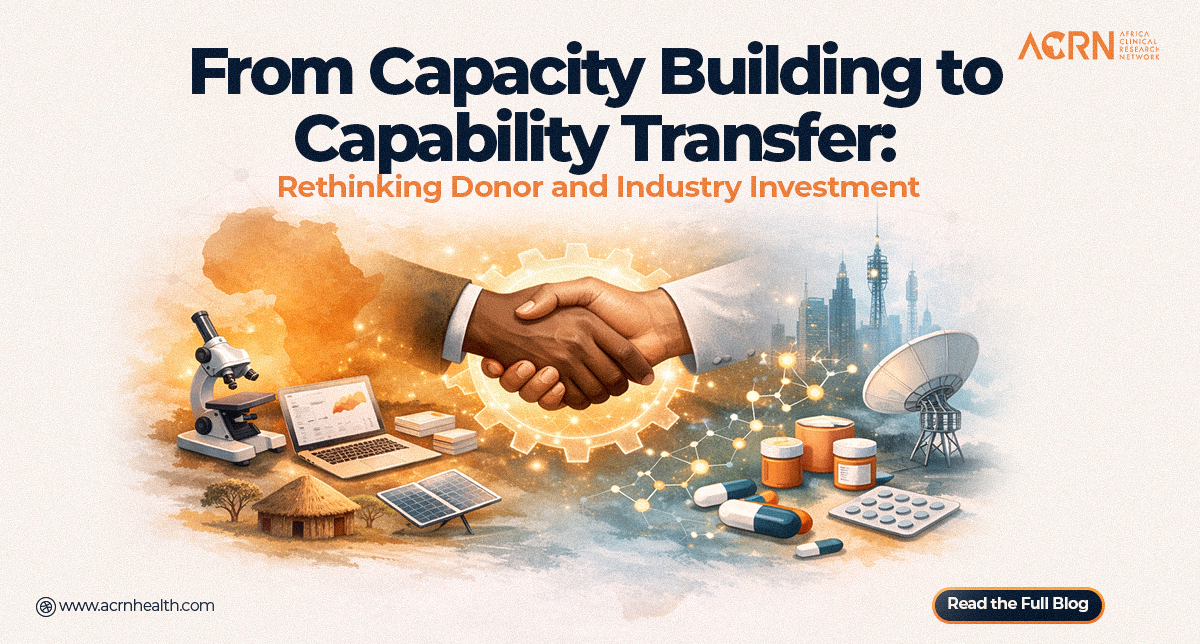
Global health rhetoric is rich with good intentions. Few terms have been as enduring or as poorly interrogated, as “capacity building”. For decades, it has served as a justification for donor spending, a line item in pharmaceutical industry corporate social responsibility reports, and a diplomatic shorthand for partnership. But here is the uncomfortable question we must now confront: After billions of dollars invested in capacity building across Africa, why do so many of the same structural deficits persist?
As the Africa Clinical Research Network (ACRN), we see these dynamics firsthand across the institutions we support. The language of capacity building continues to dominate global health discourse, yet the outcomes often fall short of what African institutions require for long‑term research leadership.
The challenge is not a lack of effort. It is a misdiagnosis of the problem. Too often, the global health sector has conflated capacity building with capability transfer and the distinction matters profoundly.
When Training Does Not Translate into Transformation
Across the African health research ecosystem, a familiar pattern emerges. A donor-funded programme convenes workshops, distributes certificates, produces reports, and concludes within the funding cycle. Participants gain knowledge. Institutions, however, frequently see limited structural change.
A growing body of global health literature suggests that research capacity-strengthening interventions in low- and middle-income countries (LMICs) often prioritize short-term outputs over long-term institutional integration, raising questions about sustainability and systemic impact. Reviews of the evidence base note that there is limited empirical data demonstrating how training-focused initiatives translate into durable institutional capacity (1).
Similarly, analyses of external research funding highlight how allocation models often prioritize competitive “excellence” criteria, concentrating support in select institutions rather than systematically strengthening broader ecosystems (2).
Further, systematic reviews examining how research capacity development is measured find wide variation in reporting standards and limited use of standardized tools to assess long-term outcomes, suggesting that sustainability metrics themselves remain underdeveloped (3).
Training is not without value. But when short-term workshops become the dominant mode of engagement, investment risks remain episodic rather than transformative. The critical question is not how many individuals were trained. It is whether institutional systems were strengthened in ways that endure beyond project timelines.
Capacity is Temporary, Capability is Structural
Capacity speaks to the ability to perform a task, often relying on external inputs, supervision, and time‑bound funding arrangements. Capability implies something more durable: institutional ownership. It encompasses governance frameworks, regulatory maturity, procurement autonomy, sustainable financing, human capital retention, and technical infrastructure. Capability enables organizations not only to perform, but to adapt, innovate, and lead independently. African-led frameworks such as the Science, Technology and Innovation Strategy for Africa (STISA‑2024) similarly emphasize institutional capability as the cornerstone of sustainable scientific leadership (4).
Initiatives under the African Academy of Sciences (AAS), particularly its Research Management Programme in Africa (ReMPro Africa), have highlighted systemic gaps in research management infrastructure and introduced approaches aimed at strengthening institutional systems across the continent (5).
This is where donor and industry investment models require recalibration. The relevant metric is not participation — it is permanent.
The Case for Embedded Models
Genuine capability transfer is best supported through embedded, long-term models of engagement, with co-designed partnerships where expertise is integrated within institutions rather than delivered externally.
Programmes supported by the European & Developing Countries Clinical Trials Partnership (EDCTP) demonstrate elements of this approach (6). By supporting African principal investigators, strengthening regulatory systems, and investing in local trial infrastructure, EDCTP has helped shift leadership and ownership of clinical research increasingly toward African institutions. Within ACRN, we see the value of such models in regulatory strengthening, data management, and clinical trial operations where African teams lead and external expertise is integrated rather than outsourced.
When regulatory scientists are mentored within national agencies, when data management systems are built on local infrastructure, and when research governance is strengthened alongside scientific training, skills become institutional assets rather than individual attributes that dissipate over time.
As Africa’s role in global clinical research expands, driven by demographic diversity, disease burden relevance, and regulatory maturation, pharmaceutical companies face a strategic choice. Transactional, site-level training may enable a trial. Embedded regulatory, pharmacovigilance, and data science partnerships build ecosystems.
The latter creates shared value that extends beyond a single study.
Incentives and Accountability: The Structural Gap
Effective capability transfer also depends on aligning incentives across funders, governments, and institutions.
Current donor architectures often reward measurable outputs: workshop numbers, trainee counts, publication metrics. While important, these indicators do not necessarily reflect structural growth. This creates incentives that favor reportable activity over systemic resilience.
The Lancet Commission on the Future of Health in sub-Saharan Africa emphasized that sustainable health systems require governance reform, domestic financing commitments, and accountability mechanisms that extend beyond traditional donor-recipient dynamics (7). The Commission explicitly argues that structural reform, not only programmatic expansion, is essential for durable health system strengthening.
International partners must be willing to co-invest in institutional overheads, administrative systems, and long-term infrastructure, not only programme-specific costs. They must also accept longer time horizons for return on investment. For African governments, increasing predictable domestic financing for research, in line with African Union commitments, remains essential to reduce dependence on external project‑based funding.
Equally, African institutions and governments must articulate clear partnership expectations. Sustainable collaboration requires negotiation, strategic clarity, and insistence on co-designed models that prioritize institutional durability.
Towards A New Compact
This is not an argument against international investment in African health systems. On the contrary, sustained global collaboration remains essential.
But the model must evolve.
A new compact, shaped and led by African institutions is needed, one grounded in mutual accountability, embedded expertise, institutional co-design, and metrics that measure durability rather than activity.
Africa’s health research ecosystem does not require more short-term intervention. It requires partnerships that stay, systems that endure, and investment strategies aligned with long-term sovereignty.
Capability transfer is not charity. It is strategy.
And it is overdue.
References
1. Bowsher G, Papamichail A, El Achi N, Ekzayez A, Roberts B, Sullivan R, et al. A narrative review of health research capacity strengthening in low and middle-income countries: lessons for conflict-affected areas. Glob Health. 2019 Mar 26;15(1):23. doi:10.1186/s12992-019-0465-y
2. Maher D, Aseffa A, Kay S, Bayona MT. External funding to strengthen capacity for research in low-income and middle-income countries: exigence, excellence and equity. BMJ Glob Health. 2020 Mar 17;5(3). doi:10.1136/bmjgh-2019-002212 PubMed PMID: 10.1136/bmjgh-2019-002212.
3. Bilardi D, Rapa E, Bernays S, Lang T. Measuring research capacity development in healthcare workers: a systematic review. 2021 Jul 1. doi:10.1136/bmjopen-2020-046796
4. Science, Technology and Innovation Strategy for Africa 2024 | African Union. Available from: https://au.int/en/documents/20200625/science-technology-and-innovation-strategy-africa-2024
5. The African Academy of Sciences Announces New Game Changing Programme to Strengthen Research Management in Africa | The AAS. Available from: https://aasciences.africa/news/the-african-academy-of-sciences-announces-new-game-changing-programme-to-strengthen-research-management-in-africa
6. EDCTP. Home. Available from: https://www.edctp.org//
7. The path to longer and healthier lives for all Africans by 2030: the Lancet Commission on the future of health in sub-Saharan Africa. Available from: https://www.thelancet.com/commissions-do/future-health-africa