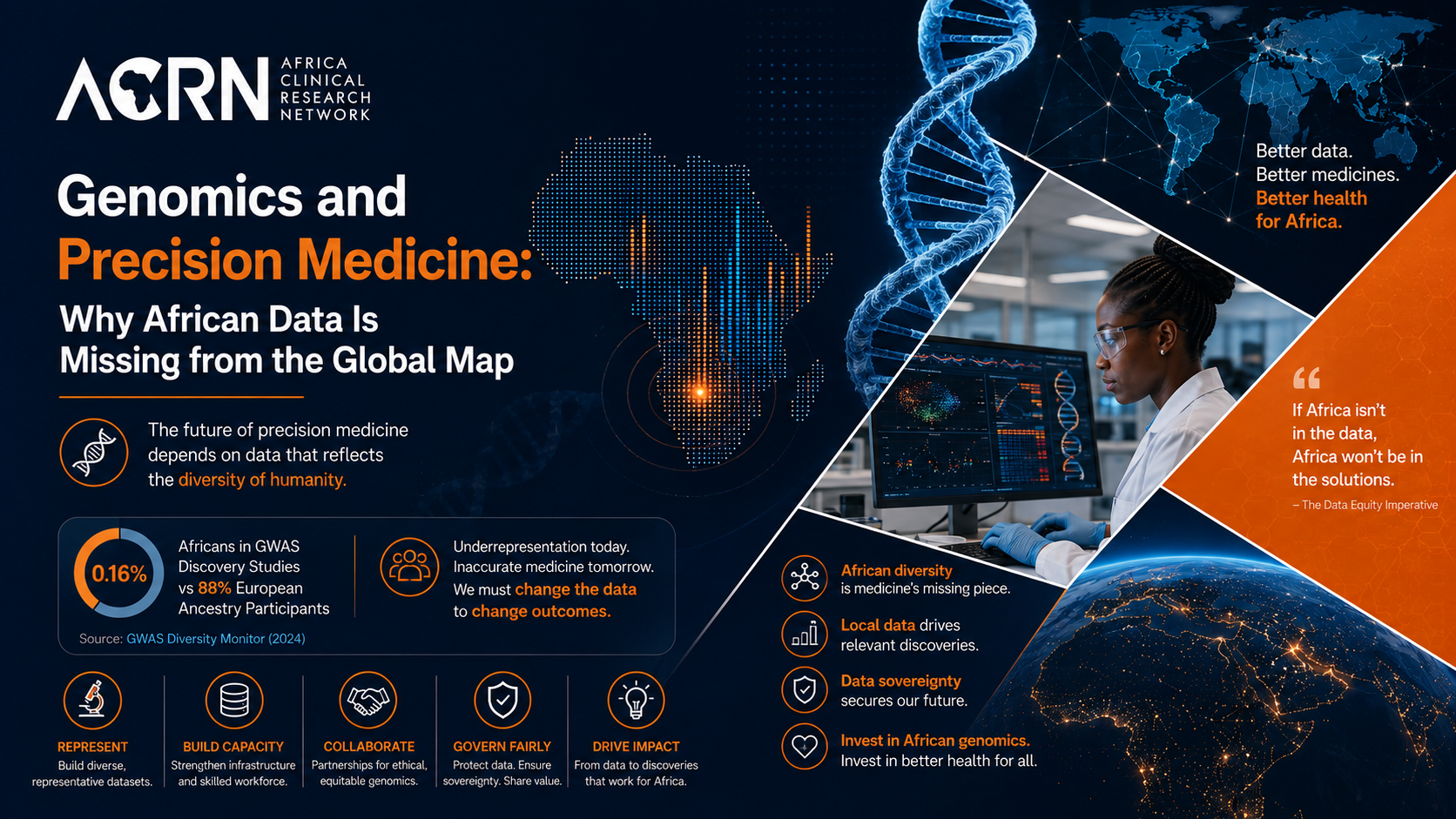
The global precision medicine project has a foundational problem. The datasets on which it is being built do not represent the species they claim to serve.
According to the GWAS Diversity Monitor, populations from the African continent account for approximately 0.16% of participants in discovery-stage genome-wide association studies, while European-ancestry participants represent nearly 88% (1).
The clinical stakes of missing data
Africa’s genetic diversity is not an abstract demographic fact. It has immediate consequences for how medicines work, how diseases are diagnosed, and how risk is calculated.
Pharmacogenomic variants that influence drug metabolism occur at different frequencies across populations. Genetic variants affecting how the body processes common HIV medications differ significantly across African populations and are frequently absent from the European datasets used to establish standard dosing. A recent policy analysis found that more than 10% of essential medicines on the World Health Organization’s list may require pharmacogenomic guidance that does not yet account for African genetic variation (2).
If the reference datasets informing drug dosing algorithms, risk scores, and diagnostic criteria exclude African variation, the clinical tools derived from them will perform poorly in African populations.
Polygenic risk scores present a related problem. Research published in Nature Medicine demonstrated that genetic risk scores derived from European-ancestry data predicted lipid traits far less accurately in sub-Saharan African cohorts, with performance varying dramatically even between African populations (3). The model fails not because biology differs across populations, but because the training data excluded the variation that matters.
The result is a precision medicine infrastructure that becomes less precise as it moves further from its reference population. For clinicians in Lagos, Nairobi, or Harare, the tools arriving from that infrastructure carry an unquantified margin of error.
The cost that compound
The first cost is clinical. Dosing algorithms calibrated to European metabolic profiles risk under-dosing or overdosing African patients. Diagnostic thresholds set against non-African reference ranges may misclassify disease. Drug targets identified in European cohorts may not be the most relevant in genetically diverse populations. Each of these represents a quiet, systemic harm that rarely shows up as a single dramatic failure but degrades the quality of care across millions of clinical encounters.
The second cost is scientific. Global genomics without African data is incomplete genomics. Variants with clinical significance that are common in African populations but rare elsewhere remain uncharacterised. The biology that could explain disease mechanisms, reveal novel drug targets, or improve risk prediction for all populations sits locked in unstudied diversity.
The third cost is economic. Genomic data is a strategic asset. Biobanks, population cohorts, and genomic databases attract research investment, pharmaceutical partnerships, and innovation ecosystems. Where African data is not generated and governed on the continent, the downstream value migrates with it.
Why correction has been slow
The gap persists not from a single cause but from several reinforcing constraints.
Funding flows remain skewed. The majority of genomics research investment still targets institutions in high-income countries studying populations of European descent. Initiatives such as Human Heredity and Health in Africa (H3Africa) have expanded capacity since 2012, but the scale of investment remains modest relative to the continent’s diversity (4).
Infrastructure concentration limits throughput. Population-scale genomics requires biobanking capacity, sequencing facilities, high-performance computing, and bioinformatics expertise. These remain concentrated in a small number of African institutions.
Data governance concerns, grounded in legitimate historical experience, create friction. Decades of sample extraction without reciprocal benefit have made African researchers and institutions appropriately cautious about data-sharing arrangements that lack protective frameworks.
Workforce gaps constrain what existing infrastructure can produce. Bioinformaticians, population geneticists, genetic counsellors, and clinical genomicists remain scarce. Training programmes are growing but have not yet reached the scale the challenge demands.
Momentum is building
The picture is not static. Several developments signal that the structural conditions for African genomics are shifting.
H3Africa has built a distributed network of biobanks, population cohorts, and trained bioinformaticians across the continent. The Three Million African Genomes initiative, endorsed by the African Union, represents the political commitment required to shift representation at scale.
In 2025, the Science for Africa Foundation, the African Population Cohorts Consortium, and the African Bioinformatics Institute launched GEN-IMPACT, a continent-led initiative designed to demonstrate the health and equity value of African genomics through a proof-of-concept platform (5). National biobanks are being established across multiple countries. Pharmacogenomic research programmes are generating population-specific data on drug metabolism for antiretrovirals, antimalarials, and other essential medicines.
A recent Nature Communications paper argues that national genome projects across Africa are now both feasible and urgent, given declining sequencing costs and maturing local infrastructure (6). The question is no longer whether African genomics can be done at scale, but whether the governance, financing, and institutional arrangements will allow it to be done well.
Where clinical research networks fit
Clinical trials sit at a natural intersection with genomics. Every trial generates a defined patient population, biological samples, clinical outcomes data, and frequently genetic sub-studies. The infrastructure already exists in embryonic form. What is missing is the deliberate decision to build genomic capacity into routine trial operations rather than treating it as an optional add-on.
For research networks operating across African populations, this means three things. First, sample collection, processing, and storage must be designed from the outset to support genomic analysis. Second, pharmacogenomic sub-studies should be embedded in clinical protocols where they can inform dosing, safety, or efficacy questions. Third, data systems must integrate genomic and clinical information securely, within governance frameworks that keep ownership and benefit where the data originates.
Done well, this turns every trial into a contribution to the broader genomic evidence base. Done poorly, or not at all, it represents a missed opportunity repeated across thousands of studies and millions of participants.
The ACRN perspective
ACRN is investing in the sample infrastructure, data governance frameworks, and analytical capacity needed to make genomic contribution a routine output of our clinical research. We hold a straightforward position: data generated through African clinical trials should remain under African governance, serve African health priorities, and feed into the global precision medicine evidence base on terms that reflect where it came from.
The most genetically diverse populations on earth should not be the least represented in the datasets shaping modern medicine. Correcting that will require sustained investment, institutional discipline, and governance that protects long-term value. The work is already underway.
References
- Leverhulme Centre for Demographic Science. GWAS Diversity Monitor: GWAS Diversity Monitor; 2026 Available from: https://gwasdiversitymonitor.com/
- University of the Witwatersrand. African genetic data could change how essential medicines are prescribed Available from: https://www.wits.ac.za/news/latest-news/research-news/2026/2026-06/african-genetic-data-could-change-how-essential-medicines-are-prescribed.html
- Kamiza AB, Toure SM, Vujkovic M, Machipisa T, Soremekun OS, Kintu C, et al. Transferability of genetic risk scores in African populations. Nature Medicine. 2022;28(6):1163–6.
- Human Heredity and Health in Africa (H3Africa). Human Heredity and Health in Africa (H3Africa)
- Science for Africa Foundation. £10 million investment in health research towards empowering African genomic discovery Available from: https://scienceforafrica.foundation/media-center/ps10-million-investment-health-research-towards-empowering-african-genomic-discovery
- Alimohamed MZ, El-Kamah G, Hamdi Y, Vicente-Crespo M, Ndiaye R, Ramsay M. Advancing global genomic equity: making a case for national genome projects in Africa. Nat Commun. 2026;17(1):5572.