
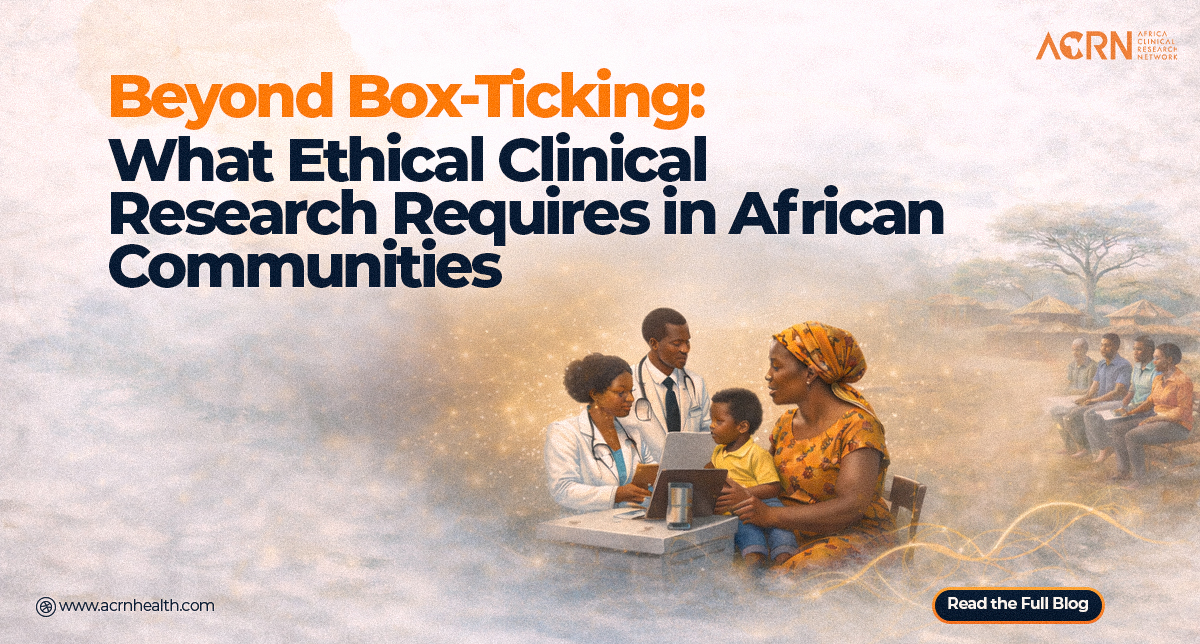
Ethics in clinical research has never been a matter of paperwork alone. Yet in practice, ethical quality is still too often judged by whether the right forms were signed, the right approvals were secured, and the protocol was followed on paper. Across African research settings, that procedural foundation remains important, but it is not sufficient on its own (1). The more difficult question is whether research teams are building trust, supporting meaningful informed consent, and engaging communities in ways that hold up under day-to-day operational realities. That is where ethical clinical research is ultimately tested.
The more pressing question is not only whether communities are included, but how research is conducted once it arrives on the ground. In many settings, ethical quality is shaped less by what is written in the protocol than by how consent is handled, how concerns are addressed, how local staff communicate with participants, and whether communities experience the research as respectful, transparent, and worth trusting.
The Legacy We Are Working Against
Any serious conversation about research ethics in Africa must contend with history. The history of externally designed research conducted with limited local benefit-sharing has shaped how some communities, institutions, and health systems continue to view research participation today (2). From colonial-era experimentation to more recent controversies around informed consent in multinational trials, the trust deficit is neither imagined nor irrational.
Governance frameworks and ethical oversight have improved substantially in many African countries over the past two decades. Yet historical memory continues to shape present-day perceptions of research. In practical terms, that history can influence how quickly rumours spread, how confidently field teams are received, and whether participants interpret research procedures as protective or suspicious.
This history influences how communities receive research teams. It determines whether a village health worker feels comfortable referring participants to a trial site. It affects whether a mother brings her child back for a follow-up visit. Ethical clinical research in Africa today cannot be understood outside of this context, and any framework that ignores it is already incomplete.
Consent as Conversation, Not Transaction
Informed consent remains central to ethical research, but in practice it is often reduced to a document-driven exercise. A long consent form, translated too literally, delivered too quickly, or explained without enough opportunity for questions may satisfy a procedural requirement without ensuring genuine understanding. In many African research settings, meaningful consent depends not only on what is written in the document, but on language, literacy, time, trust, and the skill of the person guiding the discussion (2,3).
In many settings, informed decision-making is shaped by family, social, and community relationships as well as by individual choice. Recognizing these realities does not displace individual autonomy; it helps research teams support informed choice in ways that are more context-sensitive and practically effective. It requires time. It may involve consultation with family members or community leaders, not because individual autonomy does not matter, but because decision-making often occurs within social and family structures. Recognizing these dynamics does not weaken autonomy, it situates it within the realities of people’s lives (4).
Operational experience consistently shows that when research teams treat consent as an ongoing conversation rather than a single administrative event, participant understanding improves, retention rates increase, and the quality of the data itself benefits. Ethical practice and scientific rigor are not in tension here. They reinforce one another.
In operational terms, this means research teams should treat consent as a process rather than a one-off event (3). That may include checking understanding more than once, allowing time between initial explanation and enrolment, revisiting key risks during follow-up visits, and giving participants clear opportunities to ask questions or withdraw without pressure. These small practices often do more to protect participants than consent paperwork alone.
Community Engagement That Goes Beyond Consultation
Community engagement is now widely recognized in clinical research, but recognition on paper does not always translate into meaningful practice. It appears in grant applications, ethics submissions, and regulatory guidelines. But there is a significant difference between engagement as a line item and engagement as a genuine practice.
Meaningful community engagement begins before recruitment starts and should continue throughout the life of a study (5). In practice, this may involve early discussions with community representatives, careful attention to how information is introduced locally, use of trusted communication channels, and mechanisms for communities to raise concerns after the study is underway, not only before it begins (5).
In practice, this may look like community advisory boards that provide meaningful input into study design and implementation. Where community advisory boards are used, their value depends on whether they are genuinely functional rather than symbolic. Evidence from African clinical trial settings shows that strong community advisory boards can help interpret local concerns, contextualize consent processes, manage rumours, and support recruitment and retention. At the same time, they may be less effective when they lack independence, training, or clear operational guidance (6,7).
Critically, it also requires transparency about what a study can and cannot deliver. In communities where healthcare access may already be limited, the presence of a research team can easily be perceived as a substitute for clinical care. Ethical engagement requires clear communication about what the study can offer, what it cannot offer, and where the boundaries between research participation and routine clinical care remain.
Trust Is Built in Operations, Not in Documents
The ethical character of a research programme is usually revealed in routine operations: in how staff communicate, how concerns are handled, and what happens when the protocol does not neatly answer a real-world problem.
- How are adverse events communicated to participants?
- What happens when a participant wants to withdraw from a study?
- How does the team respond when community concerns fall outside the protocol but still affect trust?
These are not minor implementation details. They are often the moments in which participants decide whether a study team is trustworthy (2). A site that allows withdrawal without pressure, explains delays honestly, responds respectfully to rumours, and communicates adverse events clearly is practicing ethics in a way that participants can actually experience.
These operational realities are where ethics lives or dies. A study can have an impeccable protocol and fully approved ethics documentation, yet still cause harm through careless implementation. Conversely, a well-run research site with strong community relationships and a culture of reflective ethical practice can navigate difficult dilemmas in ways that no standard operating procedure can fully anticipate.
This is why building ethical research capacity in Africa is not solely about training people to complete regulatory documents. It is about cultivating a professional culture in which ethical reasoning informs everyday operational decisions. That culture is often visible in supervision, staff training, escalation pathways, and whether frontline teams are encouraged to raise ethical concerns early rather than treating them as disruptions to delivery.
Looking Forward
As Africa’s role in global clinical research continues to grow, there is an opportunity not only to expand participation, but to shape more credible models of ethical practice. That will require more than importing frameworks or meeting minimum compliance standards. It will require research programmes that take consent seriously as a process, treat community engagement as part of study operations rather than public relations, and recognise trust as something built through consistency, transparency, and respectful conduct over time.
Strengthening African leadership in research design, ethics review, site management, data governance, and publication will be central to that shift. When research is shaped by people and institutions that understand the communities involved, ethical questions are more likely to be identified early and handled with greater contextual sensitivity.
Formal ethical guidance still matters. But ethical clinical research is ultimately judged in practice: in conversations with participants, in the integrity of field operations, and in whether communities experience research as something done with them rather than merely around them. That is where box-ticking ends, and ethical research begins.
References
- Edwards SJL, Silaigwana B, Asogun D, Mugwagwa J, Ntoumi F, Ansumana R, et al. An ethics of anthropology‐informed community engagement with COVID‐19 clinical trials in Africa. Dev World Bioeth. 2022 Aug 9;10.1111/dewb.12367. doi:10.1111/dewb.12367 PubMed PMID: 35944158; PubMed Central PMCID: PMC9538500.
- Molyneux CS, Peshu N, Marsh K. Trust and informed consent: insights from community members on the Kenyan coast. Soc Sci Med. 2005 Oct 1;Building Trust and Value in Health Systems in Low- and Middle- Income Countries61(7):1463–73. doi:10.1016/j.socscimed.2004.11.073
- The challenge of community engagement and informed consent in rural Zambia: an example from a pilot study | BMC Medical Ethics | Springer Nature Link [Internet]. [cited 2026 Mar 13]. Available from: https://link.springer.com/article/10.1186/s12910-019-0382-x?
- Kengne-Ouafo JA, Nji TM, Tantoh WF, Nyoh DN, Tendongfor N, Enyong PA, et al. Perceptions of consent, permission structures and approaches to the community: a rapid ethical assessment performed in North West Cameroon. BMC Public Health. 2014 Oct 2;14(1):1026. doi:10.1186/1471-2458-14-1026
- Bain LE, Akondeng C, Njamnshi WY, Mandi HE, Amu H, Njamnshi AK. Community engagement in research in sub-Saharan Africa: current practices, barriers, facilitators, ethical considerations and the role of gender – a systematic review. Pan Afr Med J. 2022;43:152. doi:10.11604/pamj.2022.43.152.36861 PubMed PMID: 36785694; PubMed Central PMCID: PMC9922083.
- Pancras G, Sunguya BF, Sirili N, Balandya E, Lyamuya E, Mmbaga BT. The role of community advisory boards in community-based HIV clinical trials: a qualitative study from Tanzania. BMC Med Ethics. 2022 Jan 8;23(1):1. doi:10.1186/s12910-021-00737-w
- Mugenyi L, Mijumbi A, Nanfuka M, Agaba C, Kaliba F, Semakula IS, et al. Capacity of community advisory boards for effective engagement in clinical research: a mixed methods study. BMC Med Ethics. 2021 Dec 15;22(1):165. doi:10.1186/s12910-021-00733-0