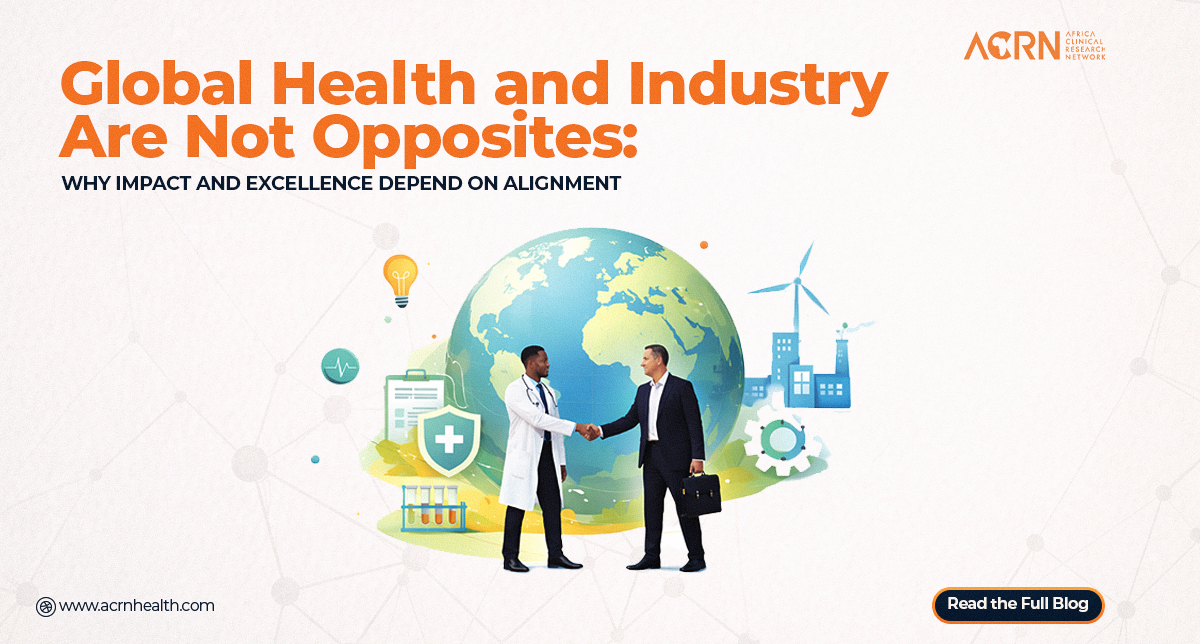
A familiar narrative in global health frames the pharmaceutical industry and global health priorities as fundamentally opposed: one driven by profit, the other by people. It is a compelling framing, but one that is often too simplistic to be useful.
The more important question is not whether commercial and public-health motives are identical. It is whether incentives, partnerships, and delivery systems can be structured so that commercial success and health impact reinforce one another rather than pull apart.
The COVID-19 pandemic exposed real fractures in how medical research is funded, how products are distributed, and in who receives access to vaccines and treatments across different geographies (1). But the greater risk now is allowing those failures to harden into a permanent narrative in which commercial incentives are treated as inherently suspect and partnership is treated as compromise. That framing makes alignment harder at exactly the moment stronger collaboration is needed.
As one analysis argues, treating global health and innovation as opposing camps risks entrenching a divide that must instead be bridged (2). When innovation and delivery align, outcomes improve materially. The issue is often less one of incompatibility than of weak coordination, poorly aligned incentives, and uneven system design.
The Problem Isn’t Motive — It’s Structure
Criticism of pharmaceutical engagement in global health is not baseless. Investment patterns do tend to favor areas with clearer commercial returns, and that leaves diseases or markets with weaker revenue prospects under-supported. But this is better understood as a structural issue than a purely moral one: companies respond to the incentive systems within which they operate. When those incentives shift, behavior often shifts with them (3).
This is one reason the case for expanding clinical research in Africa should not be framed as charity. It is a shift in where value is created and where evidence is generated. The 2024 Access to Medicine Index found that only 43% of clinical trials analyzed were conducted in any low-or middle-income country (LMIC), despite LMICs being home to nearly 80% of the global population. Only 3.5% of trials took place in low-income countries at all (4).
Africa contains the greatest amount of known human genetic diversity, which has important implications for how representative global biomedical evidence can be (5). Excluding these populations from clinical trials limits the completeness and applicability of the global evidence base.
Where Incentives Align
In practice, both philanthropic and commercial actors benefit from several of the same conditions:
- diverse and clinically relevant participant populations
- efficient, high-quality trial execution
- data that is acceptable to regulators
- research systems capable of supporting long-term market and access pathways
Several analyses and industry commentaries suggest that well-run trial sites in Africa can offer strong recruitment performance, good retention, and efficient identification of eligible participants.
In some settings, participant populations may include lower prior treatment exposure in specific disease areas, which can affect screening patterns and timelines. Any such advantage, however, should be understood in context rather than treated as a universal feature.
Delays in clinical development carry real commercial and operational consequences, which is one reason efficient trial execution remains important to sponsors.
African markets are increasingly being discussed as strategically important over the long term, particularly as population growth, urbanization, and demand for health products continue.
COVID-19 Showed Why Concentrated Research Capacity Is a Global Risk
One of the clearest lessons from COVID-19 was that concentrated research capacity creates systemic vulnerability. When too much clinical research capability is clustered in a small number of geographies, the global system becomes less resilient to disruption.
Excluding large regions from clinical research ecosystems does not only create access problems. It also weakens preparedness, slows evidence generation across diverse populations, and leaves global health responses more exposed to future shocks. Expanding trial capacity and inclusion in Africa is therefore not just an equity question. It is also a resilience and health-security question (6).
COVID-19 also reinforced that underrepresented populations are not peripheral to global outcomes. Pathogen spread, population diversity, and uneven access all shape the quality and relevance of the global evidence base.
Excellence and Impact Are Not Opposites
Experience from HIV, tuberculosis, and malaria research in Africa shows that expanding research geographically does not require lowering standards. What it requires is deliberate investment in training, infrastructure, quality systems, and long-term research partnerships (7).
Programmes such as the European & Developing Countries Clinical Trials Partnership (EDCTP) have played an important role in strengthening research partnerships, investigator development, and trial capacity across multiple African countries (7).
Quality in clinical research is built through sustained investment in people, systems, and infrastructure. Expecting global standards without that investment risks reinforcing exclusion rather than rigour.
What Real Alignment Looks Like in Practice
Alignment between commercial and global health priorities is already visible in practice, even if it is uneven. More companies are being required or encouraged to think more seriously about representative trial design, earlier market access planning, and the relevance of data across populations. At the same time, regulatory and operational conditions in parts of Africa are evolving, with stronger trial networks, growing capacity, and continued discussion around harmonization.
These shifts do not eliminate the gap, but they do show that impact and excellence can move in the same direction when incentives and systems are better aligned (6).
Conclusion
The pharmaceutical industry does not always serve global health priorities, and global health actors do not always engage fully with commercial realities. But treating these as opposing camps is increasingly unhelpful.
The more important question is how research systems, incentives, and partnerships are designed. When those structures remain unbalanced, both impact and commercial value are weakened. When they are better aligned, scientific validity improves, resilience strengthens, and access pathways become more realistic.
The real challenge is not choosing between impact and excellence. It is building the conditions in which both are possible at the same time. Africa is central to that effort, not as an exception, but as part of the future of how better clinical research gets done.
References
- Vaccine inequity: Ensuring Africa is not left out | Brookings [Internet]. [cited 2026 Apr 14]. Available from: https://www.brookings.edu/articles/vaccine-inequity-ensuring-africa-is-not-left-out/
- Moran M. The Grand Convergence: Closing the Divide between Public Health Funding and Global Health Needs. PLoS Biol. 2016 Mar 2;14(3):e1002363. doi:10.1371/journal.pbio.1002363 PubMed PMID: 26933890; PubMed Central PMCID: PMC4775017.
- Lexchin J. Profits First, Health Second: The Pharmaceutical Industry and the Global South. Int J Health Policy Manag. 2024 May 18;13:8471. doi:10.34172/ijhpm.2024.8471 PubMed PMID: 39099498; PubMed Central PMCID: PMC11270595.
- Patients in low- and middle-income countries largely left out of clinical trials, limiting access to new treatments | Access to Medicine [Internet]. [cited 2026 Apr 16]. Available from: https://accesstomedicinefoundation.org/resource/patients-in-low-and-middle-income-countries-largely-left-out-of-clinical-trails-limiting-access-to-new-treatments
- Tishkoff SA, Reed FA, Friedlaender FR, Ehret C, Ranciaro A, Froment A, et al. The genetic structure and history of Africans and African Americans. Science. 2009 May 22;324(5930):1035–44. doi:10.1126/science.1172257 PubMed PMID: 19407144; PubMed Central PMCID: PMC2947357.
- Strengthening and expanding capacities in clinical trials: advancing pandemic prevention, preparedness and response in Africa | Nature Communications [Internet]. [cited 2026 Apr 15]. Available from: https://www.nature.com/articles/s41467-024-53126-3.
- Nyirenda T, Bockarie M, Machingaidze S, Nderu M, Singh M, Fakier N, et al. Strengthening capacity for clinical research in sub-Saharan Africa: partnerships and networks. Int J Infect Dis IJID Off Publ Int Soc Infect Dis. 2021 Sep;110:54–61. doi:10.1016/j.ijid.2021.06.061 PubMed PMID: 34216733.