
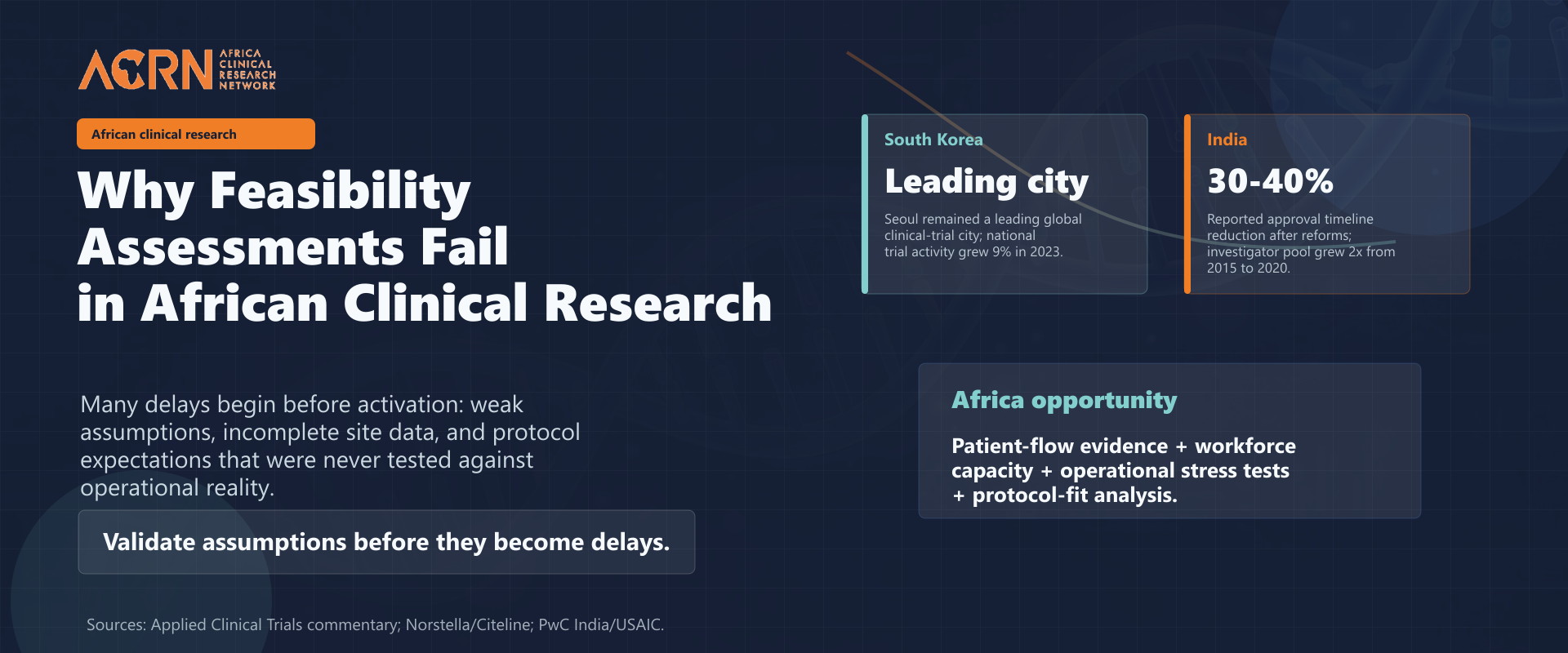
What if many clinical trial delays attributed to African sites begin much earlier — in weak feasibility design?
When a study misses its first-patient-in date or enrolment lags, the explanation is often reduced to a familiar shorthand: “Africa is difficult.” But that phrase hides more than it explains. In many cases, the delay began months earlier, when feasibility assessments relied on weak assumptions, incomplete site data, unrealistic protocol expectations, or insufficient validation of patient flow, workforce capacity, logistics, and local care pathways.
Geography is often used as an explanation when feasibility design has not been stress-tested properly.
The clinical research industry has known for years that feasibility is one of its weakest links. Kenneth Getz noted in Applied Clinical Trials that sponsor-adjusted site feasibility projections have been reported anecdotally to be accurate less than 10% of the time; the same article noted that fewer than half of sites typically meet or exceed enrolment goals (1). More recent work has echoed the point: site feasibility remains burdensome, fragmented, and in need of clearer data, collaboration, and standardization (2). ACRP has cited industry benchmarks showing that start-up delays, missed enrolment timelines, and delayed study completion remain common across clinical research globally (3).
So, the issue is not unique to Africa. The issue is global. But in African settings, weak feasibility can quickly become a damaging narrative about the continent itself.
Why Weak Feasibility Becomes an African Delay Narrative
Regulatory pathways, ethics timelines, import permits, sample logistics, staffing models, budget cycles, and vendor availability can all affect trial execution. But these are not mysteries. They are design inputs.
A delayed laboratory contract is not an “Africa problem.” A protocol that assumes urban imaging access across a dispersed rural population; a recruitment forecast based on memory rather than documented patient flow; a site expected to screen, consent, process samples, upload data, and manage queries without coordinator back-up are not an “Africa problem.” These are all feasibility design failures, and they should be identified before activation begins.
These issues should be identified during feasibility, not discovered during activation.
Why The Standard Feasibility Form Is Not Enough
Most feasibility surveys still ask familiar questions: How many patients do you have? What equipment is available? How many trials have you conducted? How quickly can you recruit?
Patient counts are frequently aspirational. A clinic may see 1,000 patients with a condition each year, but that does not mean 1,000 are eligible. Eligibility depends on diagnosis, lab thresholds, prior treatment, comorbidities, travel capacity, consent likelihood, and competing studies. “Patient pool” is not the same as “screenable population.” Nor is screenable population the same as enrollable population.
Infrastructure is usually reported, not stress-tested. A site may have a centrifuge, a -80°C freezer, or an electronic medical record. The real question is whether those assets can perform under protocol conditions: narrow processing windows, courier cut-off times, temperature excursion reporting, and audit-ready documentation.
A site may have the equipment required on paper, but feasibility should test whether the equipment, staff, documentation, maintenance systems, and back-up processes can support the protocol under real timelines.
The operational workforce is often invisible. Trials are delivered by coordinators, nurses, pharmacists, data managers, community liaisons, monitors, and investigators with protected time. ACRP’s 2025 workforce survey reported that only 33% of respondents viewed trial operations as efficient industry-wide, while 52% said hiring and retaining clinical research staff had worsened compared with five to 10 years earlier (4). Workforce capacity is not a footnote. It is feasibility. In African settings where experienced coordinators, research nurses, pharmacists, and data managers may be shared across studies or clinical duties, feasibility must account for protected time, back-up coverage, and retention risk.
Separate Protocol Feasibility from Site Capacity
One of the most costly mistakes in clinical operations is blaming sites for protocols that were never operationally fit.
A protocol can be scientifically sound and still unrealistic in a given geography. Visit frequency, imaging requirements, cold-chain needs, biospecimen export, mobile connectivity, prohibited medications, reimbursement models, and caregiver burden can all determine whether a study is executable.
WHO’s 2024 clinical trials guidance emphasizes better design, conduct, oversight, coordination, and country-led research ecosystems (5). That principle should change how we think about African feasibility. The question is not simply, “Can this site do the study?” The better question is, “What must be true for this protocol to work here, and have we validated those conditions?”. That shift changes feasibility from a form-filling exercise into an upstream risk-management process.
What Stronger African feasibility Should Look Like
A stronger model starts with data triangulation. Patient-flow estimates should be checked against clinic registers, disease registries, electronic medical record exports, pharmacy logs, laboratory volumes, district health information, or referral patterns. No single dataset is perfect. Multiple imperfect datasets are often stronger than one optimistic survey response.
It includes operational stress tests. Can the site process samples within the required window? Can a monitor reach the site on the planned cadence? Can the pharmacy manage accountability, storage, and dispensing? Can participants return for visits without losing wages or paying unsustainable transport costs? Can contracts, vendors, couriers, laboratory partners, and community-engagement activities be activated within the required sequence?
It prices the workforce, not just the infrastructure. Feasibility should document coordinator tenure, back-up coverage, workload, training history, pharmacist availability, query management capacity, and staff retention risk.
If a protocol requires more coordination time than the budget recognises, the feasibility assessment has failed before recruitment begins.
It also includes protocol-fit analysis and a coordination map. The protocol should be mapped against the local care pathway, patient journey, diagnostic access, referral flow, language needs, and seasonal constraints. Regulatory submissions, ethics review, contracting, vendor onboarding, permits, data systems, laboratory activation, and community engagement should be owned, sequenced, and tracked.
Feasibility is not a questionnaire. It is a risk-management discipline.
Lessons from Korea and India
South Korea’s rise as a clinical trial hub is not accidental. Industry analysis from Norstella positions South Korea, and Seoul in particular, as a leading global clinical-trial hub, supported by strong institutional data systems, site performance, and trial infrastructure (6). Sponsors trust markets where institutions can produce reliable patient flow, performance, quality, and timeline data.
India offers another lesson. Reporting on a PwC India and US-India Chamber of Commerce study, The Economic Times noted that regulatory reforms since 2013 and the New Drugs and Clinical Trial Rules of 2019 streamlined approvals and reduced timelines by 30–40%; the report also noted that India’s investigator pool doubled between 2015 and 2020 (7). Perceptions changed as the operating environment became more predictable.
The opportunity for African Clinical Research
Africa carries a substantial share of the global disease burden, yet remains significantly underrepresented in global clinical trial activity (8). That imbalance matters for access, evidence relevance, regulatory capacity, and trust.
But inclusion alone is not enough. More trials in Africa must also mean better-designed trials in Africa.
At ACRN, the position is clear: African feasibility should be rigorous, evidence-led, and designed to give sponsors, sites, regulators, and communities a more realistic view of delivery risk. That means patient-flow evidence rather than estimates; workforce data rather than assumptions; operational stress tests rather than infrastructure inventories; and protocol-fit analysis rather than copy-paste global templates. It also means risk registers with clear owners, timelines, mitigations, and escalation pathways.
The next time a trial delay is attributed to “Africa,” ask a more useful question: Which assumption was not validated? Which handoff lacked an owner? Which protocol requirement was never tested against reality?
Africa should not be treated as a risk category. Poorly designed feasibility should.
The future of African clinical research will not be built by promising easy execution. It will be built by making complexity visible, pricing it accurately, coordinating it deliberately, and proving that operational maturity is not defined by geography. It is defined by design.
References
- Is Investigative Site Feasibility Feasible? | Applied Clinical Trials Online [Internet]. 2026 [cited 2026 May 4]. Available from: https://www.appliedclinicaltrialsonline.com/view/investigative-site-feasibility-feasible
- Bruneau B, Surdam K, Bland A, Krueger A, Wise A,CotarlanA, et al. Redefining feasibility in clinical trials: Collaborative approaches for improved site selection. Contemp Clin Trials Commun. 2024 Aug 1;40:101291. doi:10.1016/j.conctc.2024.101291
- Fixing Feasibility: Collaborative Approaches for Redefining and Improving Site Selection – ACRP [Internet]. [cited 2026 May 4]. Available from: https://acrpnet.org/2024/03/21/fixing-feasibility-collaborative-approaches-for-redefining-and-improving-site-selection
- Townsend L. ACRP Publishes Results from First-Ever National Workforce Survey. ACRP [Internet]. 2025 Sep 24 [cited 2026 May 4]. Available from: https://acrpnet.org/2025/09/24/acrp-publishes-results-from-first-ever-national-workforce-survey
- Guidance for best practices for clinical trials [Internet]. [cited 2026 May 4]. Available from: https://www.who.int/publications/i/item/9789240097711
- Spotlight on South Korea: Innovation, clinical trials, and market trends shaping 2025.Norstella[Internet]. [cited 2026 May 4]. Available from: https://www.norstella.com/insight/spotlight-south-korea-innovation-clinical-trials-market-trends-shaping-2025/
- clinical-trial-opportunities-in-india.pdf [Internet]. [cited 2026 May 4]. Available from: https://www.pwc.in/assets/pdfs/consulting/management-consulting/clinical-trial-opportunities-in-india.pdf
- World Economic Forum [Internet]. 2025 [cited 2026 May 4]. Clinical trials are key to improvingmedicinesaccess in Africa. Available from: https://www.weforum.org/stories/2025/07/healthcare-access-africa-clinical-trials/