
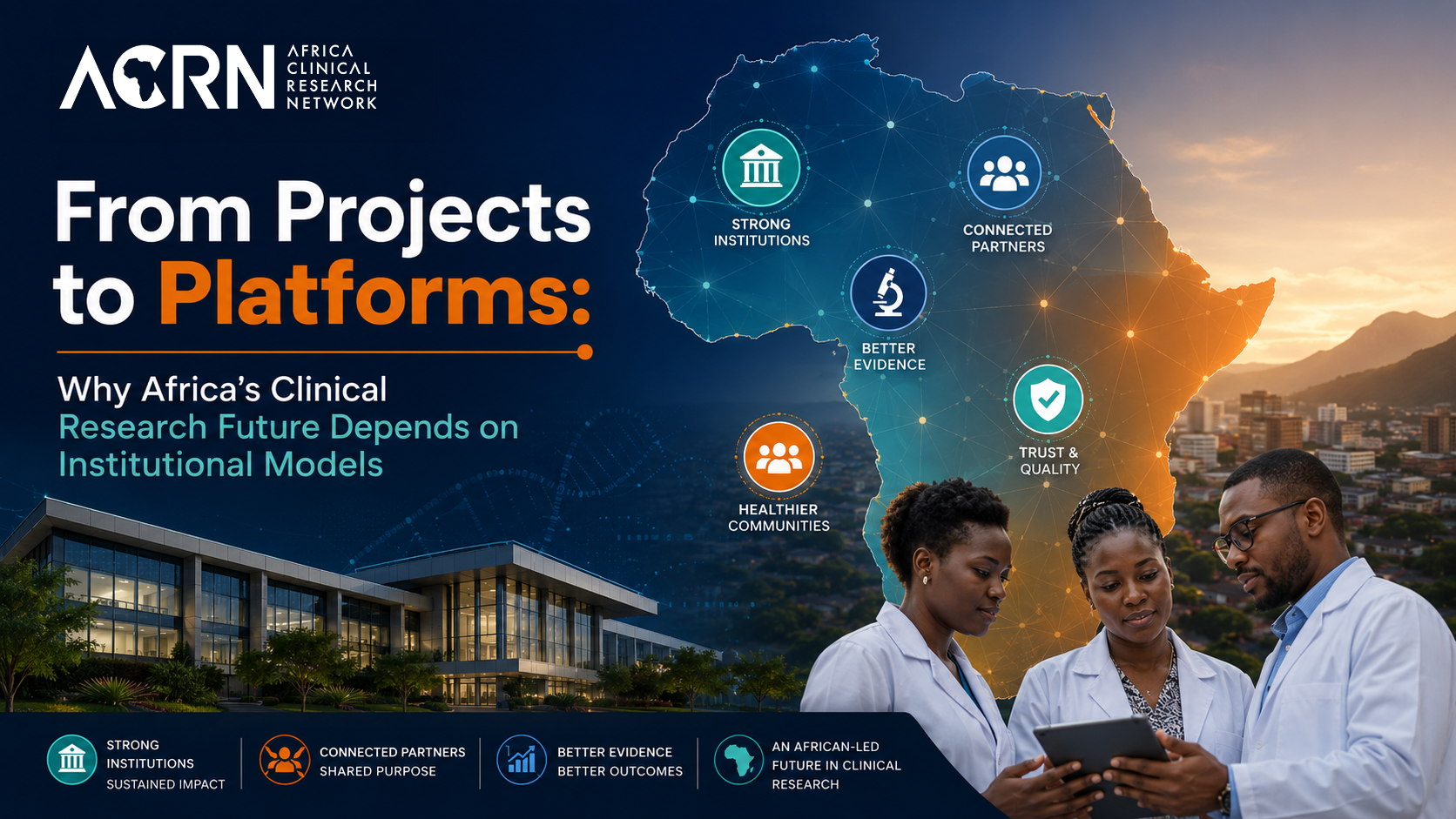
A clinical trial can leave behind a valuable dataset, a published paper and a team with new experience. It can also leave behind an empty office, expired service contracts, underused equipment and research professionals searching for the next grant.
The difference is not the quality of the science. It is whether the project was delivered through an institution capable of retaining what the project created.
For decades, much of clinical research in Africa has been financed and organized around individual grants, studies and disease-specific programmes. This model has supported important research and generated evidence with local and global value. Projects will remain essential: they provide defined questions, resources, timelines and accountability.
But projects are temporary by design. They cannot, on their own, provide the continuity required to retain specialist staff, maintain quality systems, preserve institutional knowledge or support long-term relationships with regulators, sponsors and communities.
Africa’s next phase of clinical research growth will therefore depend not only on attracting more studies, but on building institutions in which successive studies can accumulate value.
The hidden cost of starting again
When every trial begins as a largely new undertaking, the visible cost is delayed study activation. The less visible cost is institutional fragmentation.
Contracts are renegotiated without the benefit of established frameworks. New personnel must be recruited and trained. Laboratories and data systems are assessed again. Standard operating procedures are rebuilt or adapted for one protocol. Community relationships may be reactivated only when recruitment is about to begin.
Each of these activities may be necessary for a particular study. The problem is that the learning they produce is not always retained in a form that benefits the next one.
This creates a cycle in which experienced investigators continue to deliver strong research, but the surrounding system repeatedly returns to an earlier stage of development. Individual competence grows, while institutional memory remains vulnerable.
Projects are units of scientific work. Platforms are units of institutional continuity.
A platform is more than a network
The word “platform” is sometimes used loosely to describe a group of sites, a database or a collaboration. A durable clinical research platform requires more.
It needs a stable institutional home, clear governance and defined decision rights. It needs research professionals whose roles and career pathways do not depend entirely on one protocol. It needs quality-management, data, laboratory and regulatory systems that are maintained between studies rather than recreated for each one.
It must also be able to contract, manage resources and accept accountability as an institution. A sponsor or funder should be able to engage an identifiable entity with the authority and operational depth to coordinate work across programmes, sites or countries.
This does not mean centralizing every function or replacing the autonomy of strong research institutions. Effective platforms can be distributed. What matters is that their component institutions operate through agreed standards, dependable systems and governance that survives changes in individual personnel.
Continuity changes the nature of partnership
A project-based partnership often begins with a protocol: who can recruit, which site has the relevant population, and what resources are needed to deliver the study?
A platform-based partnership begins earlier and extends further. It asks whether institutions can jointly plan a portfolio of research, maintain reusable infrastructure, develop shared contracting approaches and learn across multiple studies.
For sponsors, this can reduce the uncertainty associated with identifying capabilities and rebuilding delivery arrangements for each trial. For funders, it allows investment in assets that can support more than one grant. For regulators, it creates more consistent institutional counterparts with established quality and compliance systems.
For investigators and research professionals, continuity creates a stronger basis for long-term technical careers. For communities, it means engaging with institutions that remain present before, during and after an individual study.
In this model, partnership is not limited to participation in a project. It becomes a mechanism for strengthening the institutions through which research is repeatedly designed, governed and delivered.
Africa already has parts of the answer
The case for institutional models is already reflected in Africa’s own research priorities.
The African Union Development Agency’s Health Research and Innovation Strategy for Africa 2018–2030 identifies gaps in research financing, human and infrastructure capacity, knowledge management, collaboration and regulatory systems. Its objectives call for sustained, integrated and coordinated research, more durable financing mechanisms, stronger data platforms and greater regulatory and ethics alignment. These are institutional requirements, not simply project activities. (1)
The Science for Africa Foundation’s Clinical Research and Trials Community programme similarly emphasizes coordination, visibility of existing capabilities and the long-term sustainability of Africa’s clinical-trial ecosystem. Its framing recognizes that isolated interventions will not resolve unevenly distributed capability or make research systems easier for partners to understand and engage. (2)
There are also established African examples of what continuity can make possible. Wellcome’s major research partnerships include institutions and programmes such as the Kenya Medical Research Institute–Wellcome Trust Research Programme, established in 1989, and the Malawi-Liverpool-Wellcome Research Programme, established in 1995. Their structures and histories differ, but both demonstrate the value of long-term institutional relationships that combine research delivery, infrastructure, scientific development and community engagement. (3)
Other regions reinforce the same lesson. Singapore’s biomedical research system, for example, links public research institutes, national centers, talent development, translational research and industry partnerships through enduring institutions (4). The lesson is not that African countries should reproduce Singapore’s model. It is that research ecosystems become more capable when infrastructure, talent, governance and partnerships are developed as parts of a connected system rather than as unrelated investments.
What should accumulate between trials
The practical test of a platform is what remains active when one study closes and before the next begins.
Governance should remain functional. Quality systems should continue to be reviewed. Laboratories, data platforms and biorepositories should be managed as institutional assets, with clear responsibility for their maintenance and use.
Research professionals should be retained wherever sustainable financing allows, reducing the loss of specialized expertise after each funding cycle. Regulatory knowledge should be documented and shared rather than held by a few individuals. Community engagement should continue as a relationship, not restart as a recruitment activity.
Financing must also become more diversified. A platform that depends on one grant or sponsor remains exposed to the same discontinuity as a single project. Durability requires a considered mix of research grants, sponsor-funded trials, institutional investment, service agreements and public or philanthropic support, appropriate to the mandate of each institution.
Most importantly, each project should leave the institution stronger. Its lessons should improve future feasibility assessments, contracting, quality management, regulatory planning, data practices and participant engagement.
The objective is not to eliminate project cycles. It is to ensure that the value created within them accumulates.
From access to institutional confidence
Strong platforms also change how African institutions participate in research partnerships.
An institution with dependable governance, credible data, experienced teams and repeatable delivery systems can engage partners from a position of greater confidence. It can assess whether a study fits local priorities and operational realities. It can negotiate timelines and responsibilities with better evidence. It can contribute to protocol design and portfolio planning rather than entering the process only when sites are being selected.
This is not primarily about rhetoric or institutional size. It is about being able to demonstrate, consistently, that an organization can make decisions, manage risk, meet its obligations and learn across studies.
That capability benefits the wider ecosystem. Strong platforms can connect established and emerging sites, provide shared technical resources, support common standards and make distributed expertise more visible. They can help sponsors and funders engage capable institutions without assuming that every site must develop every function independently.
The platform logic for ACRN
For the Africa Clinical Research Network, this platform logic is central to the work ahead.
The objective is not to replace capable African research institutions or to position one organization as the center of the ecosystem. It is to connect institutions through governance, shared systems, regulatory coordination and dependable delivery arrangements that can support research across studies and over time.
A pan-African platform must recognize that research environments differ across countries and institutions. Its value will depend on balancing common standards with local knowledge, and coordinated execution with institutional accountability.
It must also be built with patience. Governance, trust and reliable systems cannot be created by declaration. They are established through repeated delivery, transparent decision-making and the ability to correct weaknesses without losing institutional continuity.
What the next chapter requires
The coming years will still be filled with projects. The more important question is what those projects will accumulate into.
When each study leaves behind stronger governance, reusable systems, experienced professionals, better data, durable relationships and a broader financial base, projects become building blocks of institutions.
When those assets repeatedly disperse, even excellent science may leave the wider system only marginally stronger than before.
Africa’s clinical research future will not be determined solely by the number of studies the continent hosts. It will also be determined by whether those studies strengthen institutions capable of shaping, governing and delivering the research that follows.
Projects produce evidence. Platforms preserve the ability to keep producing it.
References
- African Union Development Agency (AUDA-NEPAD). Health Research and Innovation Strategy for Africa (HRISA): 2018–2030. African Union Development Agency (AUDA-NEPAD); 2019.
- Foundation SfA. Clinical Research & Trials Community (CRTC) Programme: Science for Africa Foundation; [Available from:https://scienceforafrica.foundation/programmes/clinical-research-and-trials-community.
- Wellcome. Our Major Research Partnerships in Africa and Asia: Wellcome; [Available from:https://wellcome.org/research-funding/funding-portfolio/major-partnerships-africa-asia.
- Agency for Science TaRAS. Organisation Structure [Available from:https://www.a-star.edu.sg/about/corporate-profile/organisation-structure.