
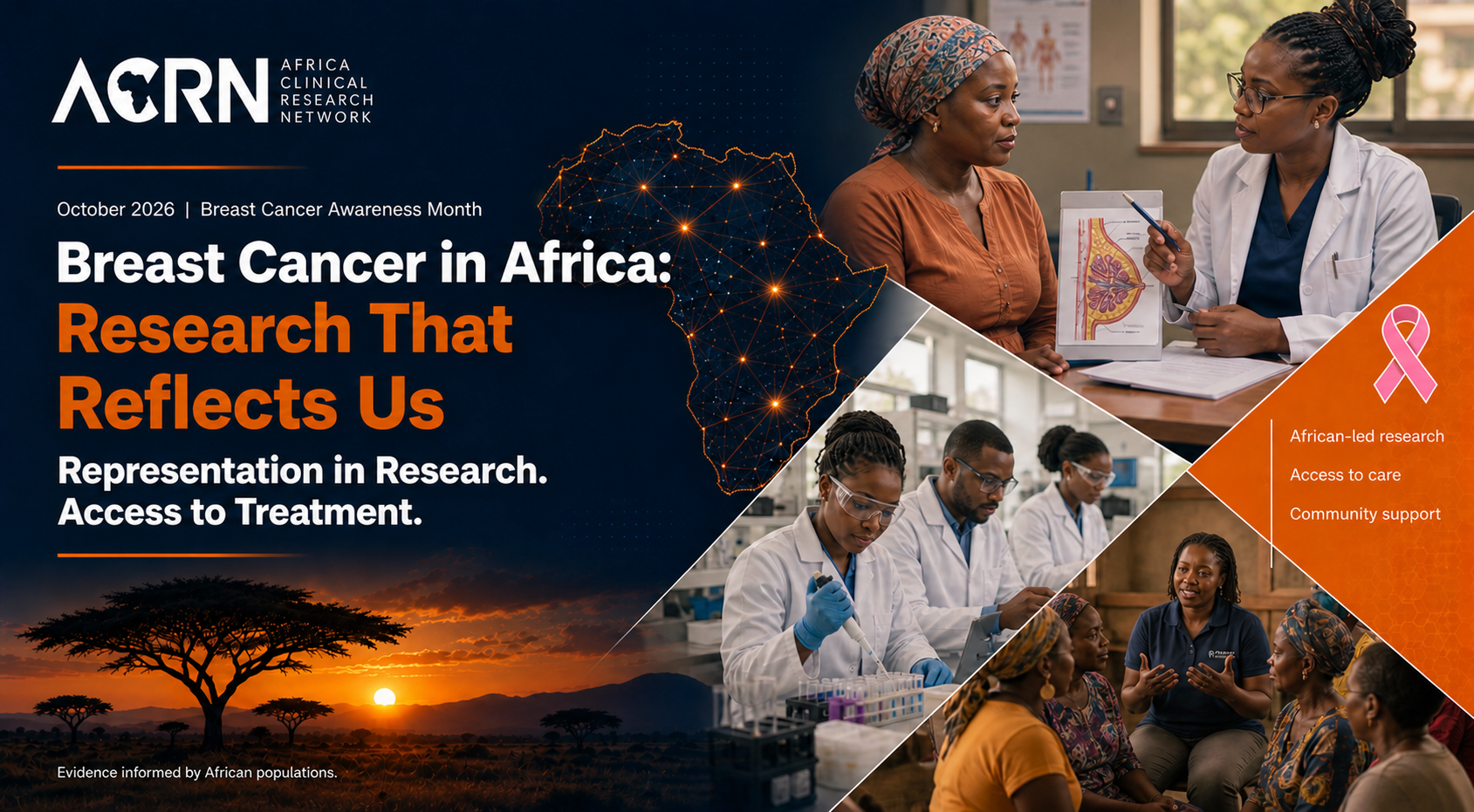
At a supermarket checkout in Harare recently, I was asked whether I would donate my change to breast cancer research. It was a small request, but an encouraging one: a local business recognizing that research deserves our support.
It also raised a bigger question. When an African woman develops breast cancer, how much of the science guiding her care reflects women like her, and how much of that care can she actually access?
A GLOBOCAN-based analysis estimated approximately 198,000 new breast cancer cases and 91,000 deaths across Africa in 2022 (1). These figures demand more than awareness. They demand earlier diagnosis, effective treatment and research that connects the two.
Understanding the disease without generalizing the continent
That connection begins with understanding the disease. Breast cancer is not one illness: its molecular characteristics influence how it behaves and which treatments work.
Triple-negative breast cancer lacks estrogen and progesterone receptors and does not overexpress HER2, the protein targeted by HER2-directed therapies. In US registry data from 2017 to 2021, it accounted for approximately 19% of breast cancer diagnoses among Black women, compared with 9% among White women (2).
A systematic review of African studies estimated a pooled frequency of 27%, but found substantial variation between studies and rated the certainty of evidence as very low (3). This is not a definitive estimate for every African population.
Science can identify the right treatment. Access determines whether it reaches the patient.
A treatment must be more than available
Today, breast cancer treatment includes surgery, radiotherapy, chemotherapy, endocrine medicines, targeted therapies and immunotherapy, with the combination determined by the disease and the individual patient. Comprehensive care also includes rehabilitation and palliative care (4, 5).
Yet the presence of a service does not tell us whether women can use it. The World Health Organization’s (WHO) assessment of breast cancer control capacities in 2022 reported chemotherapy availability in 37 of 42 responding countries in the WHO African Region (5). Country-level availability, however, is not the same as affordable, timely care for an individual woman.
Research by Ghanaian oncologist Verna Vanderpuye and colleagues illustrates that distinction. In a survey conducted in 2018 and published in 2021, respondents from 30 facilities across 21 sub-Saharan African countries reported that trastuzumab, a HER2-targeted medicine, was available in 66% of facilities. Yet respondents reported that fewer than 20% of patients could afford to pay for it out of pocket (6).
These are findings from the surveyed facilities, not a current continent-wide measure of access. Nevertheless, the distinction remains important: a medicine on a hospital shelf is not the same as a completed course of treatment.
Access also begins before a prescription. Reliable pathology and receptor testing help clinicians determine which treatments are appropriate (5, 6). Awareness campaigns therefore need to connect women to timely assessment, accurate diagnosis, referral and continuing care. Encouraging women to seek help must be accompanied by investment in the services that follow.
What Zimbabwean tamoxifen research tells us
Access is only part of the scientific challenge. We must also understand how treatments perform in the populations receiving them.
Zimbabwean scientist Collen Masimirembwa’s research with clinical and laboratory colleagues brings this into sharp focus. Here, the question concerns not only the tumor, but also how the patient’s body processes a medicine.
Tamoxifen is used for hormone receptor-positive breast cancer, not triple-negative disease. It is converted into the active metabolite endoxifen through a process involving the enzyme cytochrome P450 2D6 (CYP2D6). Certain genetic variants that reduce this enzyme’s activity, including variants relatively common in some African-ancestry populations, can reduce endoxifen formation (7).
In a study of 40 Zimbabwean patients involving Masimirembwa, Anna Mary Nyakabau and colleagues, 55% had endoxifen concentrations below a proposed therapeutic threshold (7). This was a finding about drug concentrations. It did not establish that treatment had failed in 55% of patients.
A subsequent prospective Zimbabwean study involving Masimirembwa enrolled 51 women receiving tamoxifen. It reported estimated two-year event-free survival of approximately 40% among CYP2D6 intermediate metabolizers, compared with 84% among normal metabolizers. Here, event-free survival meant remaining alive without breast cancer recurrence or progression. The estimates had wide confidence intervals, particularly in the smaller intermediate-metabolizer group (8).
These small observational studies do not establish that tamoxifen fails Black women, or that genetic variation alone explains the differences observed. Neither tested whether changing treatment according to genotype improves survival. They are not a reason for patients to stop or change prescribed treatment without their oncology team.
They do, however, raise an important research question: can treatment informed by genetic variation improve outcomes, and how could that approach be delivered affordably?
Answering that question would help move the discussion from identifying differences to determining whether acting on them benefits patients.
African women must help shape the evidence
Generating that evidence requires studies involving African women in the settings where they receive care. It also requires precision about what existing research can tell us.
A 2026 registry-based analysis examined breast cancer trials registered between 2010 and 2020 in low- and middle-income countries. It described trial locations, designs and planned sample sizes, but did not provide a continent-wide total of African women actually enrolled in therapeutic trials (9). Counts of studies should not be presented as counts of women represented in the evidence.
Nigeria’s ARETTA trial offers a concrete example of research conducted in African care settings. Atara Ntekim and colleagues, including Olufunmilayo Olopade, enrolled 53 women with nonmetastatic, HER2-positive breast cancer across four Nigerian academic hospitals. The study evaluated treatment beginning with docetaxel chemotherapy and trastuzumab before surgery (10).
This was a small, single-arm study without a comparison group, not definitive evidence that one regimen was superior to another. Its relevance is that it generated treatment evidence with women receiving care in Nigerian institutions and provided a basis for further investigation (10).
Together, the work of these researchers shows why breast cancer research must address more than one question. We need to understand the disease, how patients process medicines, how treatments perform and what prevents women from receiving them.
That requires adequately powered, ethically conducted studies, reliable laboratories and long-term follow-up. It also requires research into the practical conditions of care: diagnostic delays, treatment costs, interruptions and the support patients need to continue treatment.
Turning local support into lasting progress
The willingness of local businesses and communities to support this work is encouraging. It creates an opportunity to connect public concern with clearly defined research and care priorities.
That support should complement sustained public and institutional funding, not replace it. Research campaigns should explain which questions donations will help answer and how progress will be reported. Where funds also support patient care, that purpose should be clear.
The goal should be measurable progress: timely diagnoses, appropriate treatment, fewer interruptions in care and evidence that reflects the women being treated.
That is what the generosity behind the donation at the checkout should help make possible. Not awareness alone, but a future in which African women help shape the science and can access the care it makes possible.
References
- Fu M, Peng Z, Wu M, Lv D, Lyu S, Li Y. Assessing the African burden of breast cancer: A demographic analysis using Global Cancer Observatory 2022. European Journal of Surgical Oncology. 2025;51(5).
- Giaquinto AN, Sung H, Newman LA, Freedman RA, Smith RA, Star J, et al. Breast cancer statistics 2024. CA: A Cancer Journal for Clinicians. 2024;74(6):477–95.
- Hercules SM, Alnajar M, Chen C, Mladjenovic SM, Shipeolu BA, Perkovic O, et al. Triple-negative breast cancer prevalence in Africa: a systematic review and meta-analysis. BMJ Open. 2022;12(5):e055735.
- National Cancer Institute. Breast Cancer Treatment: National Cancer Institute; Available from: https://www.cancer.gov/types/breast/treatment.
- World Health Organization Regional Office for Africa. Assessment of breast cancer control capacities in the WHO African Region in 2022. Brazzaville: WHO African Region; 2024. Report No.: 9789290314110.
- Vanderpuye V, Dadzie M-A, Huo D, Olopade OI. Assessment of Breast Cancer Management in Sub-Saharan Africa. JCO Global Oncology. 2021(7):1593–601.
- Mbavha BT, Thelingwani RS, Chikwambi Z, Nyakabau AM, Masimirembwa C, and the Consortium for G, et al. Pharmacogenetics and pharmacokinetics of tamoxifen in a Zimbabwean breast cancer cohort. British Journal of Clinical Pharmacology. 2023;89(10):3209–16.
- Mazhindu TA, Chase ED, Joel M, Ndlovu N, Borok MZ, Masimirembwa C, et al. Pharmacogenomic Impact on Breast Cancer Survival for Black Zimbabwean Patients on Tamoxifen. JCO Global Oncology. 2025(11):e2500367.
- Chowdhury AM, Halaseh SA, Joseph D, Abel AI, Jha N, Al-Karadsheh A, et al. Breast cancer clinical trials in low- and middle-income countries (LMICs). Ecancermedicalscience. 2026;20:2112.
- Ntekim A, Popoola A, Sowunmi A, Olasehinde O, Sanni A, Ibraheem A, et al. Pragmatic Clinical Trial Assessing Response to Neoadjuvant Docetaxel and Trastuzumab in Nigerian Women With Human Epidermal Growth Factor Receptor 2–Positive Breast Cancer (ARETTA). JCO Global Oncology. 2026;12(5):e2500287.