
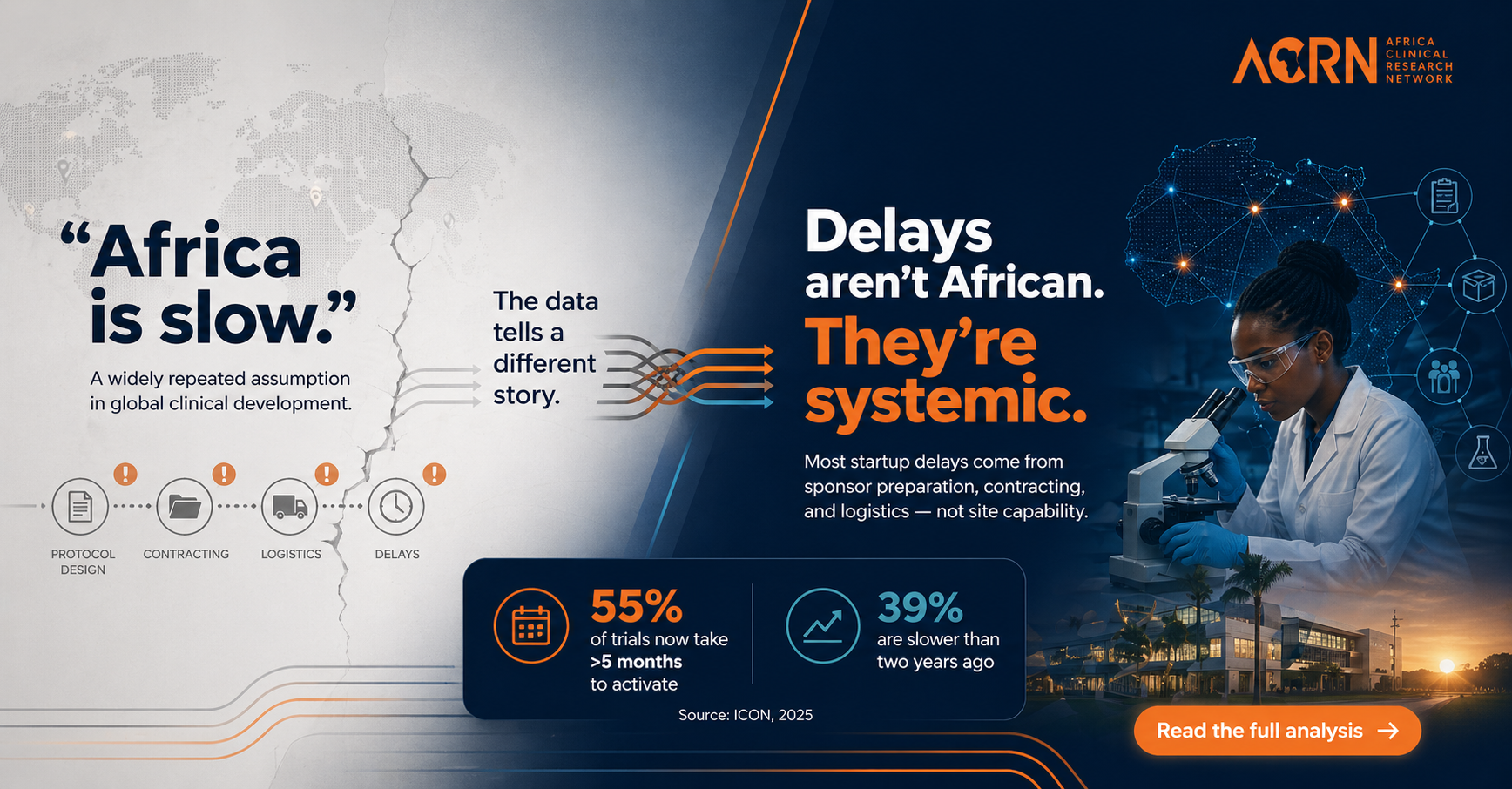
It is one of the most durable assumptions in global clinical development, and one of the least examined. It appears in sponsor discussions, conference panels, and country-selection assumptions.
But clinical trial speed is not a continental trait. It is an operational outcome.
It depends on whether the protocol was pressure-tested before feasibility. Whether the regulatory dossier was complete. Whether contract positions were agreed before negotiation began. Whether import permits, cold-chain routes, biospecimen pathways, and site training were sequenced early enough to prevent avoidable delay.
When those elements are missing, delay is predictable. When they are present, African sites can move.
The data already points in this direction. ICON’s 2025 industry survey found that 55% of respondents reported more than five months from site selection to full activation, while 39% said timelines were longer than two years earlier. Contract and budget delays were reported frequently by 66% of respondents (1). A review of global Phase III trial start-up delays identified recurring drivers including regulatory processes, contracts and budgets, insurance, clinical supplies, site selection, site activation, and inefficient processes (2).
These are not uniquely African variables. They are system variables.
The African evidence tells the same story. A 2024 BMJ Global Health paper from Kenya reported mean time to trial activation of 80 days for COVID-related studies and 259 days for non-COVID studies at the same clinical research unit, during the same broad period (3). The difference was unlikely to be the country alone. It points instead to the operating model: urgency, parallel processing, readiness, and decisions made before the site could enroll a single participant.
That is the uncomfortable finding at the center of the African delay narrative: what is often labeled as an African site problem frequently begins upstream in sponsor preparation, protocol design, contracting, or logistics planning.
Where Timelines Actually Break
Before a participant is screened, a clinical trial typically passes through several start-up gates: protocol design, country and site selection, regulatory submission, ethics review, contracting and budgeting, and site activation. Site activation includes training, investigational product logistics, laboratory readiness and sample movement.
Each gate can create delay. In African start-up, the biggest losses are often concentrated in three areas.
First, sponsor-side preparation.
Too many African feasibility exercises begin after key design decisions are already locked. Sites are asked to confirm feasibility rather than shape it. The protocol may assume visit schedules, comparator sourcing, imaging capacity, laboratory turnaround times or sample shipment routes that were never tested against local clinical workflows.
The result is familiar: late clarifications, re-budgeting, amendment discussions, retraining and avoidable escalation. African teams inherit a clock that started running before they were meaningfully engaged.
Second, contracting and budgeting.
Contract delays are often attributed to local legal friction. In practice, many are repeated negotiations over predictable issues: indemnity, injury compensation, intellectual property, publication rights, data and sample ownership, overhead recovery, payment terms, tax and governing law.
COHRED’s Fair Research Contracting work has long argued that stronger contracting capacity is essential for equitable research partnerships, including issues such as data ownership, intellectual property, capacity building and indirect costs (4). That is not only a fairness issue. It is also an operational issue: unclear contracting positions create repeat negotiations and predictable delays.
Mature systems do not renegotiate the same clauses from zero on every study. They build template agreements, fallback positions, escalation routes and pre-approved budget logic.
Third, supply-chain and import logistics.
An excellent investigator cannot rescue a poorly sequenced import plan. A capable site cannot activate if investigational product, comparator medication, cold-chain documentation, customs clearance, courier pathways, biospecimen export approvals, or depot arrangements are treated as afterthoughts.
These are not signs of weak science. They are signs of weak coordination.
What India and China Teach us
The most useful comparators are not countries that move fast by reputation. They are countries that changed the system around clinical research.
India’s clinical-trial growth should not be understood as a sudden change in scientific capability. It reflects changes in the policy and regulatory environment that made clinical research more predictable. It introduced the New Drugs and Clinical Trials Rules, strengthened predictability in the regulatory pathway, and built a policy narrative around becoming a clinical-research hub (5). Invest India reported that the country became the third-largest destination for clinical trials globally as of 2024, with growth linked to regulatory reform, scale and infrastructure (5).
China offers a similar lesson. Since 2016, regulatory reforms have reshaped its drug-development environment by reducing backlogs and encouraging innovation; later reforms introduced expedited programmes such as priority review, conditional approval and breakthrough therapy designations (6).
Neither country changed its geography. Both changed the operating system.
Africa does not need to copy India or China. But Africa should draw the same conclusion: credibility is built through measurable systems, not defensive storytelling.
What Africa Should Build Next
The next phase of African clinical research should be defined by operational evidence.
That means publishing or internally tracking time-to-activation data by country, site, study type, and delay category. It means distinguishing regulator time from sponsor response time, ethics review from contract negotiation, import permitting from depot readiness. Without that granularity, ‘Africa is slow’ remains too easy to say and too hard to disprove.
It also means building continental and regional contracting infrastructure: model clauses, pre-negotiated positions, budget benchmarks, and fair research-contracting principles that protect African institutions without slowing every study into a bespoke negotiation.
It means sponsor-facing regulatory teams that understand both local requirements and global dossier expectations. Many delays may occur not because regulators are inherently slow, but because submissions are incomplete, poorly adapted, or badly sequenced.
And it means logistics partnerships with documented in-country experience before the first patient visit is scheduled. Import and export pathways should be mapped during feasibility, not discovered after site selection.
The encouraging news is that the foundations are already forming. AVAREF provides a continental platform for strengthening regulatory and ethics oversight, harmonization, and clinical-trial review capacity (7). The African Medicines Agency is part of a wider move from fragmented regulatory systems toward continental coordination, building on the African Medicines Regulatory Harmonization programme (8,9).
But institutions alone will not solve start-up timelines. Data, discipline and ownership will.
From narrative to operating model
At ACRN, our working position is simple: African start-up timelines should be understood through African systems, measured through better data, and improved through coordinated design. That means supporting more disciplined feasibility, clearer site-readiness assessment, better coordination across partners, and more transparent discussion of where delays actually occur
That does not absolve sponsors, CROs or global decision-makers. It makes the accountability more precise. If the delay is caused by late protocol adaptation, name it. If the bottleneck is contracting, measure it. If the issue is sample export, map it. If the dossier is incomplete, fix the preparation standard.
The Africa is slow narrative becomes much weaker when timelines are measured properly. It will be replaced by activation dashboards. By standard contracts. By logistics playbooks. By regulator-ready submissions. By sites that can show, with evidence, where time is gained and where time is lost.
The next time a trial starts late in Africa, the mature question is not “Why is Africa slow?”
It is: “Which part of the system failed — and who owns the fix?”
References
- ICON survey reveals increasing clinical trial startup delays, underscoring need for human-centredsite activation solutions | ICON plc [Internet]. [cited 2026 Apr 27]. Available from: https://www.iconplc.com/news-events/press-releases/icon-survey-reveals-increasing-clinical-trial-startup-delays
- Lai J, Forney L, Brinton DL, Simpson KN. Drivers of Start-Up Delays in Global Randomized Clinical Trials. TherInnovRegul Sci. 2021 Jan 1;55(1):212–27. doi:10.1007/s43441-020-00207-2
- Saleh M, Sharma K,ShamshudinA, Obayo I, Gondi S, Karimi N. Regulatory approval of clinical trials: is it time to reinvent the wheel? BMJ Glob Health. 2024 Jan 24;9(1):e013727. doi:10.1136/bmjgh-2023-013727
- Council on Health Research for Development – COHRED [Internet]. [cited 2026 Apr 27]. Fair Research Contracting | Council on HealthResearch forDevelopment. Available from: https://www.cohred.org/frc/
- India’s Clinical Trials Surge:Emergingas Global Innovation P… [Internet]. [cited 2026 Apr 27]. Available from: https://www.investindia.gov.in/team-india-blogs/indias-clinical-trials-surge-emerging-global-innovation-powerhouse
- Zhu X, Xiao D. Innovative Drugs Approved in China After Registration Classification Reform: Current Status, Disparities, and Challenges. ClinPharmacolTher. 2025 Oct 11;119(2):470. doi:10.1002/cpt.70084 PubMed PMID: 41075154.
- AVAREF | [Internet]. [cited 2026 Apr 27]. Available from: https://avaref.afro.who.int/
- Frontiers | The African Medicines Agency: historical perspective of its origins, evolution, institutionalstructureand future prospects [Internet]. [cited 2026 Apr 27]. Available from: https://www.frontiersin.org/journals/medicine/articles/10.3389/fmed.2026.1763261/full
- African Medicines Agency – Improving access to quality,safeand efficacious medical products for the continent. [Internet]. [cited 2026 Apr 29]. Available from: https://au-ama.africa/