
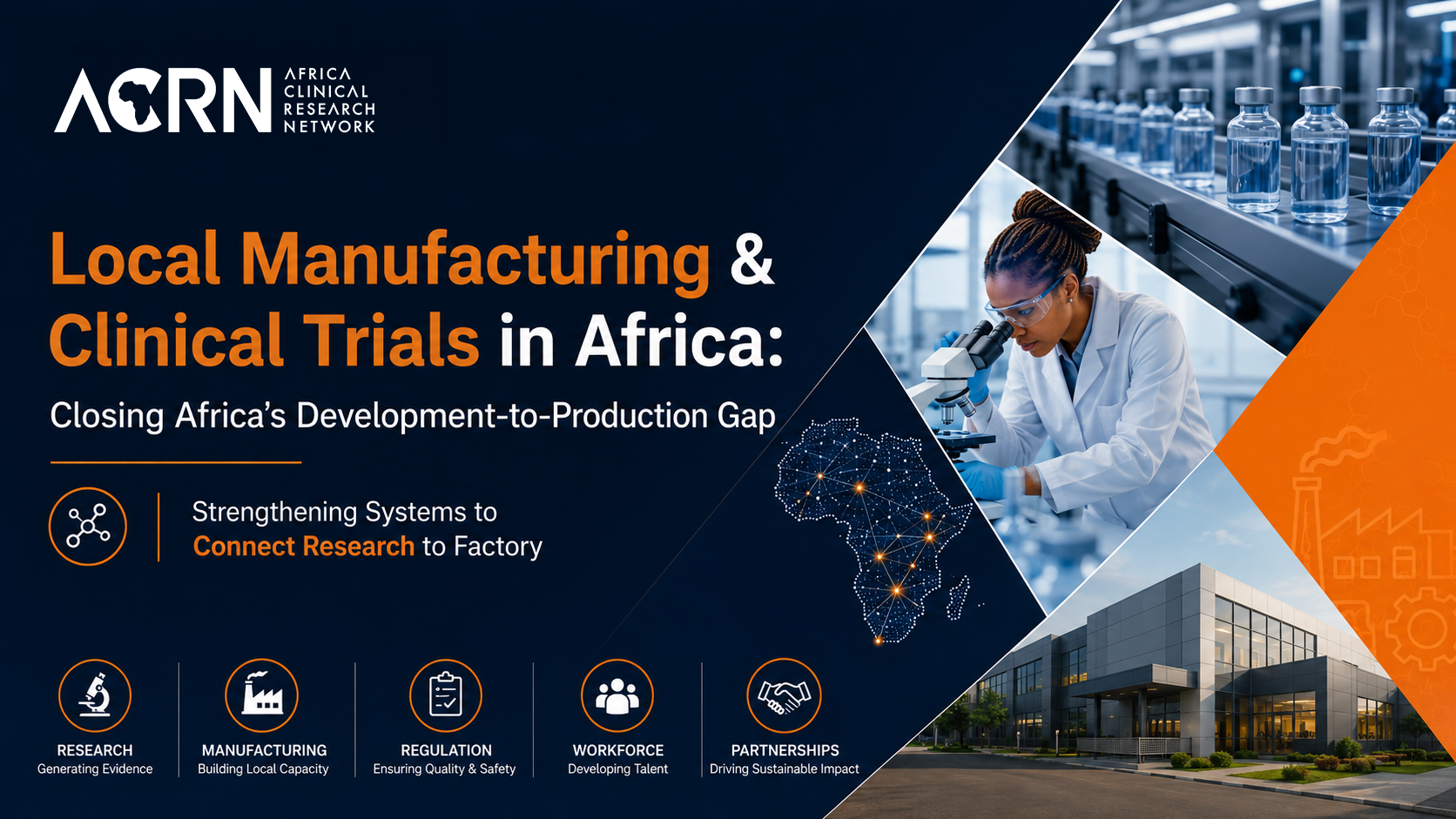
The final participant visit is usually treated as the end of a clinical trial. For Africa’s health-product economy, it should be a handover point: the moment when evidence begins to inform regulatory approval, manufacturing, procurement and delivery.
African researchers, laboratories, regulators and communities contribute to evaluating vaccines, biologics, diagnostics and therapeutics. Yet countries in the WHO African Region import 99% of their vaccines and between 70% and 100% of finished pharmaceutical products (1). The continent can therefore help establish whether a product works without gaining the capability to produce or reliably supply it.
This is not simply a shortage of factories. It is a failure to connect the institutions that generate evidence with those responsible for production, regulation, financing, procurement and public health delivery.
The missing interface
Clinical trials create valuable capabilities. They strengthen laboratories, data systems, quality management, regulatory expertise and research teams. But conducting a trial does not automatically transfer intellectual property, manufacturing processes or production know-how.
When local production is discussed only after a product succeeds, African institutions enter the conversation late. Decisions about formulation, licensing, manufacturing locations, supply chains and scale-up may already have been made. The trial may have generated evidence relevant to African populations while creating few pathways for African manufacturers to participate in producing the resulting product.
The answer is not to attach a factory to every trial site. Nor should every country attempt to manufacture every health product. Manufacturing depends on viable production volumes, predictable demand, specialized expertise, strong regulation and competitive supply chains. Fragmenting limited investment across duplicative national facilities would weaken rather than strengthen the market.
The more credible objective is strategic regional capability: the ability to identify priority products, evaluate them rigorously, manufacture selected products at viable scale and supply them across multiple markets.
That requires a better interface between development and production.
What shared infrastructure should mean
Research and manufacturing do not need to occupy the same campus. Shared infrastructure means connecting decisions, institutions and capabilities across the product pathway.
The first connection is product strategy. Researchers, manufacturers, regulators, procurement agencies and health systems should identify priority products together. A technically feasible product is not automatically a viable manufacturing opportunity. Decisions should reflect disease burden, delivery conditions, expected demand, production complexity and the ability of health systems to purchase and use the product.
The second is development planning. Dosage form, storage requirements, stability, packaging and administration affect whether a product can be manufactured and delivered effectively in African settings. Manufacturers and health systems need to inform these choices before protocols and product specifications are fixed, not after development is complete.
The third is quality and regulatory infrastructure. Research and manufacturing both depend on reliable laboratories, documented processes, data integrity, quality-management systems and inspection-ready institutions. Investments in these capabilities should reinforce one another rather than produce parallel systems that cannot exchange data or recognize each other’s standards.
The fourth is technology transfer. This is not simply permission to use a patent. It may include process knowledge, analytical methods, equipment specifications, training, quality-control procedures and regulatory documentation. Planning these elements early can reveal whether a proposed transfer is technically and commercially realistic.
The WHO mRNA Technology Transfer Programme demonstrates parts of this connected approach. Its South African hub brings together Afrigen, Biovac and the South African Medical Research Council to develop technology, build skills and transfer manufacturing knowledge to a network of partners (2). Its significance lies not only in the technology involved, but in the deliberate connection between research, process development, training and production.
Clinical trial networks as connective infrastructure
Clinical trial networks should not try to become manufacturers. They can, however, help close the institutional distance between product development and production.
Networks understand disease priorities, study populations, delivery environments and the practical requirements of multicountry research. They connect investigators, laboratories, regulators, health systems and communities. These relationships can help product developers ask better questions earlier.
A network can identify whether proposed formulations and delivery models fit regional conditions. It can connect developers with appropriate laboratories and scientific expertise, support evidence generation across multiple countries and contribute to post-market safety and effectiveness studies. It can also bring manufacturers into development discussions before technology-transfer opportunities narrow.
This does not mean compromising the independence or scientific integrity of trials. It means recognising that evidence generation, manufacturing readiness and access planning are related responsibilities within one product pathway.
The African Union’s Partnerships for African Vaccine Manufacturing Framework for Action reflects this broader ecosystem approach. Its ambition is to enable African manufacturers to supply more than 60% of the continent’s vaccine requirements by 2040, compared with less than 1% when the initiative was established (3). Gavi’s African Vaccine Manufacturing Accelerator complements that ambition by making up to US$1.2 billion available over ten years from its launch in June 2024, using incentives intended to support commercially viable vaccine manufacturing (4).
These initiatives address important production and market constraints. Their impact will also depend on whether research agendas, regulatory systems, purchasing decisions and manufacturing investments move in the same direction.
Invest in pathways, not isolated assets
Three connections deserve particular attention.
First, Africa needs shared workforce pipelines. Vaccine research and manufacturing draw on overlapping expertise in bioprocessing, quality assurance, regulatory science, laboratory systems and supply-chain management. Africa CDC has estimated that a functioning continental vaccine manufacturing ecosystem will require approximately 12,500 full-time employees, compared with about 2,000 available when its competency frameworks were introduced (5). Universities, research institutions, regulators and manufacturers should therefore design training around the full product lifecycle rather than separate professional tracks.
Second, regulatory strengthening must cover the complete pathway. Clinical trial authorisation, product registration, manufacturing inspection and pharmacovigilance are distinct functions, but they should not operate as disconnected systems. Greater regulatory alignment can reduce avoidable duplication while preserving rigorous standards and national authority.
Third, financing must reach the space between trials and factories. Research grants may finance evidence generation, while development-finance institutions support facilities and equipment. Technology transfer, process development, regulatory preparation, workforce training, product adaptation and market readiness can fall between those mandates.
The strategic unit of investment should therefore be the product pathway, not the trial or factory in isolation. Funders should ask whether an investment connects an identified health need to research, development, production, regulatory approval and a credible market. A facility without a viable product portfolio may remain underused. A successful trial without manufacturing and access planning may produce evidence while leaving supply dependence unchanged.
ACRN’s role
At the Africa Clinical Research Network, we see clinical research as part of a wider health-product system. High-quality trials generate more than data and publications. They strengthen people, laboratories, quality systems, regulatory knowledge and institutional relationships.
ACRN is not a manufacturer. Our role is to help build an African-led clinical research ecosystem that can connect effectively with manufacturers, regulators, product developers and health systems. This includes supporting rigorous multicountry research while encouraging earlier consideration of product priorities, implementation conditions and post-trial pathways.
Africa does not need a factory beside every trial site. It needs institutions capable of carrying knowledge, standards and decisions across the distance between development and production.
The continent’s development-to-production gap will not be closed by investing in more isolated projects. It will be closed when a clinical trial is no longer treated as the end of one process, but as part of a connected pathway from evidence to reliable supply.
References
- World Health Organization Regional Office for Africa. Framework for strengthening local production of medicines, vaccines, and other health technologies in the WHO African Region 2025–2035: Report of the Secretariat. Brazzaville, Republic of the Congo: WHO Regional Office for Africa; 2024.
- World Health Organization. mRNA Technology Transfer (mRNA TT) Programme: World Health Organization; [Available from: https://www.who.int/initiatives/mrna-technology-transfer-(mrna-tt)-programme]
- Africa Centres for Disease Control and Prevention. Partnerships for African Vaccine Manufacturing (PAVM) Framework for Action. Addis Ababa, Ethiopia: Africa Centres for Disease Control and Prevention; 2022 3 March 2022.
- Gavi the Vaccine Alliance. African Vaccine Manufacturing Accelerator (AVMA): Gavi the Vaccine Alliance; [Available from: https://www.gavi.org/our-work/market-shaping/regional-manufacturing-strategy/avma]
- Africa Centres for Disease Control and Prevention. Vaccine R&D and Vaccine Manufacturing Competency Frameworks. Addis Ababa, Ethiopia: Africa Centres for Disease Control and Prevention; 2023 2 November 2023.