
Four days after Uganda confirmed an outbreak of Sudan virus disease in January 2025, a clinical trial evaluating a candidate vaccine was launched. Investigators from Makerere University and the Uganda Virus Research Institute worked with the Ministry of Health, the World Health Organization (WHO), and partners to prepare the trial while meeting national and international ethical and regulatory requirements.
The preparation behind those four days had taken years. A trial protocol had been developed during the 2022 outbreak. Research teams had been trained, then given refresher training. Candidate vaccine doses were already in the country, with their storage conditions checked before use (1).
This is what standing research capacity makes possible. It does not eliminate the uncertainty of an outbreak. It reduces the operational uncertainty surrounding the response: who will lead, which procedures will apply, where supplies will come from, and how participants will be protected.
For Africa’s health security, the challenge is to make such readiness more widely available and sustainable between emergencies. Climate change adds urgency because it can alter disease risks while disrupting the infrastructure needed to investigate them.
Climate risk is also an operational risk
Changes in temperature and rainfall can affect the suitability of environments for disease vectors and the timing of transmission. Flooding can contaminate water supplies, interrupt transport, and damage health facilities. WHO’s framework for climate-resilient health systems in the African Region recognizes these interconnected pressures (2).
These relationships are not uniform. An outbreak cannot automatically be attributed to climate change, and disease patterns also reflect land use, population movement, prevention measures, and access to care. Preparedness must respond to local evidence rather than assume that every threat is increasing everywhere.
For research institutions, the implication extends beyond deciding which pathogens to study. A site may face increased demand for research at the same time that roads become impassable, electricity fails, or clinical staff are diverted to emergency care.
A laboratory’s equipment inventory therefore tells only part of the story. Can samples still reach it during a flood? Can investigational products remain within their required temperature range through a prolonged power interruption? Can participants receive follow-up care if they must leave their homes?
Climate-resilient trial preparedness means planning for research under disrupted conditions, not simply preparing to study climate-sensitive diseases.
Readiness depends on the connections between institutions
A capable research site is essential, but it cannot activate a trial alone. It needs a sponsor able to assume responsibility, investigators available to lead, reviewers able to assess the proposal, and suppliers able to deliver the required materials.
The connection with surveillance is particularly important. Detecting an outbreak should prompt a rapid assessment of the research questions that matter, not automatically trigger a clinical trial. Early priorities may include describing the illness, evaluating diagnostics, or understanding transmission. An interventional trial is appropriate when there is a worthwhile question, a scientifically sound design, and adequate safeguards.
National preparedness plans should identify who makes these decisions and how research teams connect with the outbreak response. Agreements on data access, sample transfers, contracts, and financing should be developed before they become urgent negotiations.
Supply planning must also reach beyond the site. Where a suitable investigational product exists, readiness requires arrangements for its manufacture or supply, quality documentation, importation, storage, and distribution. A trial protocol cannot compensate for a product that cannot reach participants.
This is the practical meaning of a research network: the institutions must be able to work together under pressure, not merely appear together on a map.
Prepare the science without bypassing oversight
Protocol development need not begin with a blank page each time an outbreak occurs. Investigators can prepare common research questions, outcome definitions, data collection tools, and adaptable protocols in advance. Ethics committees and regulators can help identify foreseeable concerns before an emergency.
But advance preparation is not blanket permission to proceed. Guidance arising from a WHO and African coaLition for Epidemic Research, Response and Training (ALERRT) workshop distinguishes pre-review of a generic protocol from approval of a study adapted to a specific population and setting (3).
Similarly, a master protocol does not remove the need for applicable review of new interventions or substantial amendments. Good Clinical Practice requires appropriate oversight, qualified staff, adequate resources, and protection of participants throughout the trial. Readiness is demonstrated through these functions, not established by a training certificate alone (4).
Africa also has mechanisms on which to build. The African Vaccine Regulatory Forum’s (AVAREF) emergency preparedness guidance sets out approaches to coordinated ethics and regulatory review, communication, investigational product importation, and sample transfers. It explicitly operates alongside national requirements rather than replacing them (5).
The priority is to make these pathways usable: named contacts, clear submission requirements, available reviewers, and tested communication arrangements. Authorization to conduct a trial must also remain distinct from authorization to use a product outside research.
Community preparation belongs in the same work. Before an emergency, institutions should establish ways for communities to shape study procedures, question proposed research, and raise concerns. During an outbreak, communication must explain uncertainty and preserve voluntary participation. An existing relationship is a foundation for that conversation, not a substitute for consent.
Finance the interval between studies
A funding model tied only to individual trials leaves an important question unanswered: who pays to keep essential capability available when no study is recruiting?
Governments, funders, sponsors, and research institutions should distinguish the cost of conducting a study from the cost of maintaining readiness. Core staff, laboratory maintenance, data security, quality systems, and emergency exercises require support before an outbreak creates an immediate research need.
That does not mean keeping every facility idle in anticipation of a rare event. Routine clinical research can sustain teams and systems that also support emergency studies. The additional requirement is a credible plan for changing priorities and increasing activity without abandoning existing participants or weakening essential care.
Financing should reflect both needs: predictable support for core capability and rapidly accessible funds for activation. The responsibilities of each partner should be explicit, including how additional staffing and supplies will protect routine health services.
Readiness funding should also come with evidence of performance. Institutions should demonstrate that staff are available, equipment works, agreements remain valid, and critical processes have been rehearsed.
Test readiness before an outbreak tests it
An emergency exercise can reveal weaknesses that a site assessment misses. A simulation might require teams to receive an alert, select an appropriate protocol, prepare submissions, arrange a sample shipment, and respond to a simulated safety concern.
The useful measure is not simply how quickly the exercise ends. It is where decisions stall, which responsibilities are unclear, and whether participant protection and data quality remain intact. AVAREF’s preparedness guidance includes simulation as part of testing emergency plans (5).
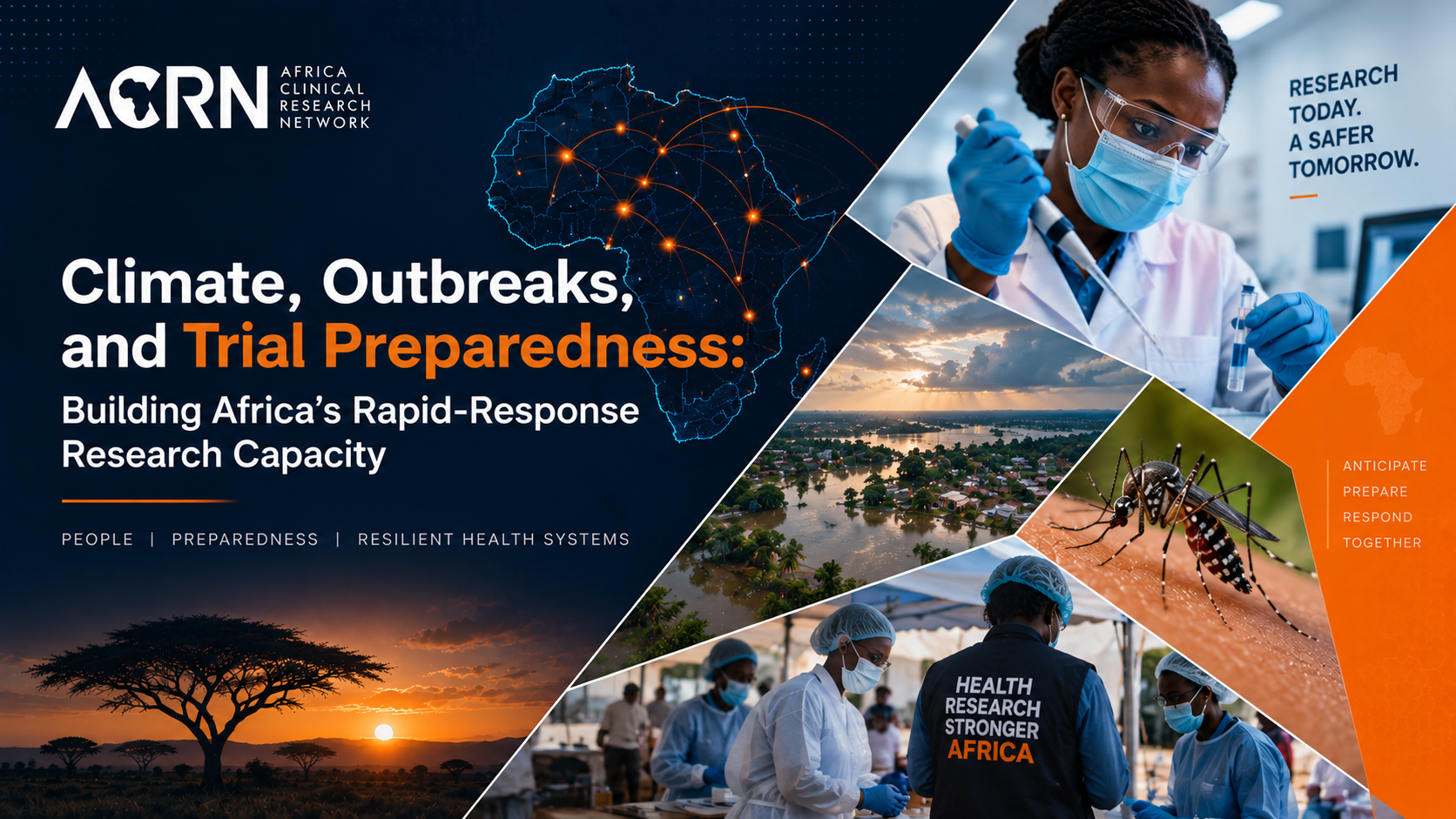
For the Africa Clinical Research Network (ACRN), this provides a practical direction for connecting routine research delivery with health security. ACRN’s work across clinical operations, regulatory support, laboratories, and data management offers relevant foundations. The preparedness task is to connect those capabilities to national response arrangements and demonstrate how they function under emergency conditions.
No network should treat emergency readiness as a permanent status. Staff change, equipment deteriorates, suppliers change, and disease risks evolve. Readiness must be maintained and tested.
The next outbreak will not wait for those arrangements to be negotiated. The investment that matters now is the work that makes a responsible research response possible when time becomes scarce: people retained, systems maintained, decisions clarified, and plans rehearsed.
That is how research becomes part of health security rather than an activity added after the emergency has begun.
References
- World Health Organization (WHO). Groundbreaking Ebola vaccination trial launches today in Uganda: World Health Organization; 2025 Available from: https://www.who.int/news/item/03-02-2025-groundbreaking-ebola-vaccination-trial-launches-today-in-uganda.
- World Health Organization Regional Office for Africa. Framework for building climate-resilient and sustainable health systems in the WHO African Region 2024–2033. Brazzaville, Republic of Congo: WHO Regional Committee for Africa, Seventy-fourth session; 2024. Report No.: AFR/RC74/9.
- Saxena A, Horby P, Amuasi J, Aagaard N, Köhler J, Gooshki ES, et al. Ethics preparedness: facilitating ethics review during outbreaks – recommendations from an expert panel. BMC Medical Ethics. 2019;20(1):29.
- International Council for Harmonisation. Guideline for Good Clinical Practice E6(R3). 2026 June 16. Report No.: E6(R3), Step 4 Final Consolidated Guideline.
- African Vaccine Regulatory Forum (AVAREF). AVAREF Strategy and Guidance for Emergency Preparedness. World Health Organization Regional Office for Africa; 2020. Report No.: AVAREF2020-SGEP, Version 4.