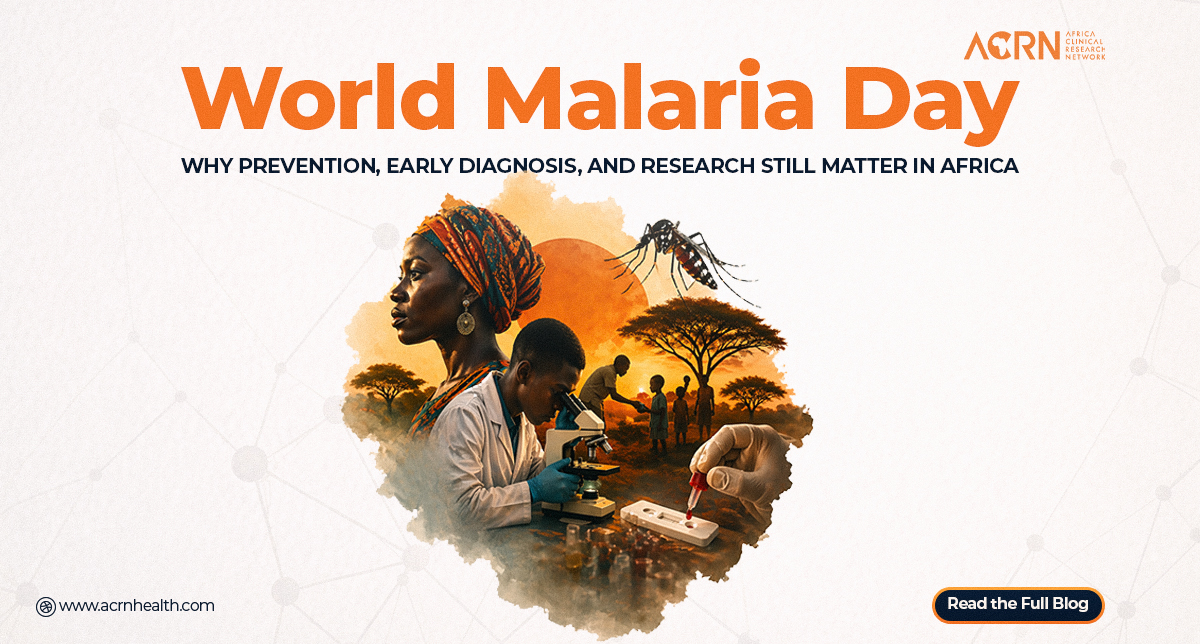
Malaria remains one of the most serious public health threats across Africa. According to the World Health Organization (WHO), there were an estimated 282 million malaria cases globally in 2024 and 610,000 malaria deaths. The WHO African Region accounted for 95% of those cases and 95% of those deaths, with children under five making up about three quarters of malaria deaths in the region. On World Malaria Day, that reality should prompt more than reflection. It should reinforce the importance of prevention, early testing, timely treatment, and continued investment in research (1).
Malaria is preventable and curable, but outcomes depend heavily on whether people can protect themselves, recognize symptoms early, get tested quickly, and access effective treatment without delay. That remains especially important for young children, pregnant women, and communities with limited access to care (1).
Why Malaria Still Demands Urgent Attention
The WHO African Region continues to carry the overwhelming majority of the global malaria burden (1). That burden is sustained by a combination of factors: exposure to mosquito vectors, gaps in prevention coverage, delayed diagnosis, uneven access to treatment, poverty, and health-system constraints that affect how quickly people can receive care (2). For many families, malaria is not an abstract threat. It is a recurring illness that can disrupt income, education, and household stability.
Climate variability and environmental change are adding to the challenge. As rainfall patterns and temperatures shift, malaria risk may change in ways that expose new populations and complicate control efforts. At the same time, resistance, both to artemisinin-based treatment and to the insecticides used in vector control, threatens to weaken progress if surveillance and innovation do not keep pace (1,3).
Hard-Won Progress Worth Defending
It would be wrong to tell only a story of crisis. Progress has been real. WHO reports that since 2000, malaria interventions have helped avert an estimated 2.3 billion cases and 14 million deaths globally (4). In Africa, insecticide-treated nets, rapid diagnostic tests, artemisinin-based combination therapies, seasonal chemoprevention, and the rollout of malaria vaccines have all strengthened the response. These are not small achievements. They are evidence that sustained investment in science and health systems saves lives.
A major scientific milestone has also been reached: WHO now recommends both RTS,S/AS01 and R21/Matrix-M malaria vaccines for children living in malaria-endemic areas, adding an important new layer to prevention efforts (5). These vaccines do not replace other interventions, but they expand the malaria-control toolbox in meaningful ways.
What Families and Communities Still Need Most
Even with better tools, malaria control still depends on practical action. Prevention remains central: consistent use of insecticide-treated nets, appropriate indoor spraying where available, seasonal chemoprevention in eligible areas, and reducing delays in care-seeking all matter.
Early testing is just as important. Fever should not automatically be treated as malaria without confirmation where diagnostic testing is available, and suspected malaria should be taken seriously, especially in children. Prompt testing helps ensure that treatment is appropriate and timely.
Early treatment saves lives. Effective antimalarial treatment works best when started quickly, before disease becomes severe (1). Public awareness, access to testing, and confidence in local health services are therefore essential parts of malaria control, not secondary issues.
The Case for African-Led Research
The global health community is increasingly recognizing that durable malaria solutions must be shaped by the settings in which the burden is highest. African scientists, clinicians, programme leaders, and communities bring essential knowledge about local transmission patterns, health-system realities, and implementation challenges. That makes African-led research not only a question of ownership, but of relevance and long-term effectiveness.
African-led clinical research is not only a matter of scientific capacity. It is also important for relevance, long-term sustainability, and stronger local decision-making. When African institutions lead research, they help generate evidence that reflects the realities of local communities, health systems, and disease patterns. They also strengthen the skills, infrastructure, partnerships, and regulatory experience needed for future public-health challenges.
For ACRN, this is part of a broader public-health commitment: supporting stronger research systems, more relevant evidence generation, and partnerships that help translate science into practical health gains for African communities.
What Still Stands in the Way
Progress is real. The obstacles are too.
Funding for malaria control and research remains under pressure and often too fragile to support long-term planning. When resources are unpredictable, prevention campaigns, surveillance systems, research programmes, and community-level services can lose momentum. African research institutions also continue to face resource gaps that limit their ability to lead large-scale studies, retain skilled teams, and move evidence efficiently into policy and practice.
Regulatory pathways across the continent remain fragmented, which can slow the translation of research into approved interventions. Drug and insecticide resistance create additional urgency. Without sustained surveillance and new product development pipelines, the medicines and tools used today may become less effective tomorrow.
Community trust remains essential. Whether the goal is prevention, diagnosis, treatment uptake, or research participation, trust must be built deliberately through communication, responsiveness, and sustained engagement.
The Path to Elimination
Ending malaria in Africa will require a practical set of commitments. Prevention tools must continue to reach households consistently. Testing and treatment must become easier to access quickly, especially for children and in under-served areas. Surveillance systems must be strong enough to track changing transmission patterns, emerging resistance, and shifting climate-related risks.
At the same time, African research institutions and public-health systems need more predictable support. Long-term investment, stronger regulatory coordination, and better integration between research and service delivery will all matter if scientific progress is to translate into lasting public-health gains.
World Malaria Day: A Practical Call to Action
The World Health Organization’s 2026 World Malaria Day theme, “Driven to End Malaria: Now We Can. Now We Must.”, captures the current moment well. There are now more tools available than before, including vaccines, next-generation nets, chemoprevention strategies, diagnostics, and better surveillance approaches. But progress will depend on whether those tools are funded, delivered consistently, and adapted to local realities (6).
The call to action should be clear. Policymakers need to protect and prioritize malaria funding. Donors and partners need to invest in institutions and systems, not only short-term projects. Researchers and clinicians need to continue building evidence that is relevant, collaborative, and usable. Communities need access to information, testing, prevention, and treatment that they can trust and act on.
Malaria deaths are preventable. That is why World Malaria Day should not only raise awareness. It should also reinforce the practical steps that save lives.
Africa has the scientific talent, the public-health experience, and the growing infrastructure to accelerate progress against malaria. What is needed now is sustained investment, stronger delivery systems, and continued commitment to prevention, early diagnosis, timely treatment, and African-led research. For ACRN, supporting that agenda is part of a broader commitment to public health across the continent.
References
- Fact sheet about malaria [Internet]. [cited 2026 Apr 24]. Available from: https://www.who.int/news-room/fact-sheets/detail/malaria
- 2024 Africa Malaria Progress Report. African Leaders Malaria Alliance [Internet]. [cited 2026 Apr 23]. Available from: https://alma2030.org/heads-of-state-and-government/african-union-malaria-progress-reports/2024-africa-malaria-progress-report/
- Ryan SJ, Lippi CA, Zermoglio F. Shifting transmission risk for malaria in Africa with climate change: a framework for planning and intervention. Malar J. 2020 May 1;19(1):170. doi:10.1186/s12936-020-03224-6
- World malaria report 2025 [Internet]. [cited 2026 Apr 24]. Available from: https://www.who.int/teams/global-malaria-programme/reports/world-malaria-report-2025
- Malaria vaccine: WHO position paper – May 2024 [Internet]. [cited 2026 Apr 24]. Available from: https://www.who.int/publications/i/item/who-wer-9919-225-248
- World Malaria Day 2026 [Internet]. [cited 2026 Apr 23]. Available from: https://www.who.int/campaigns/world-malaria-day/2026