
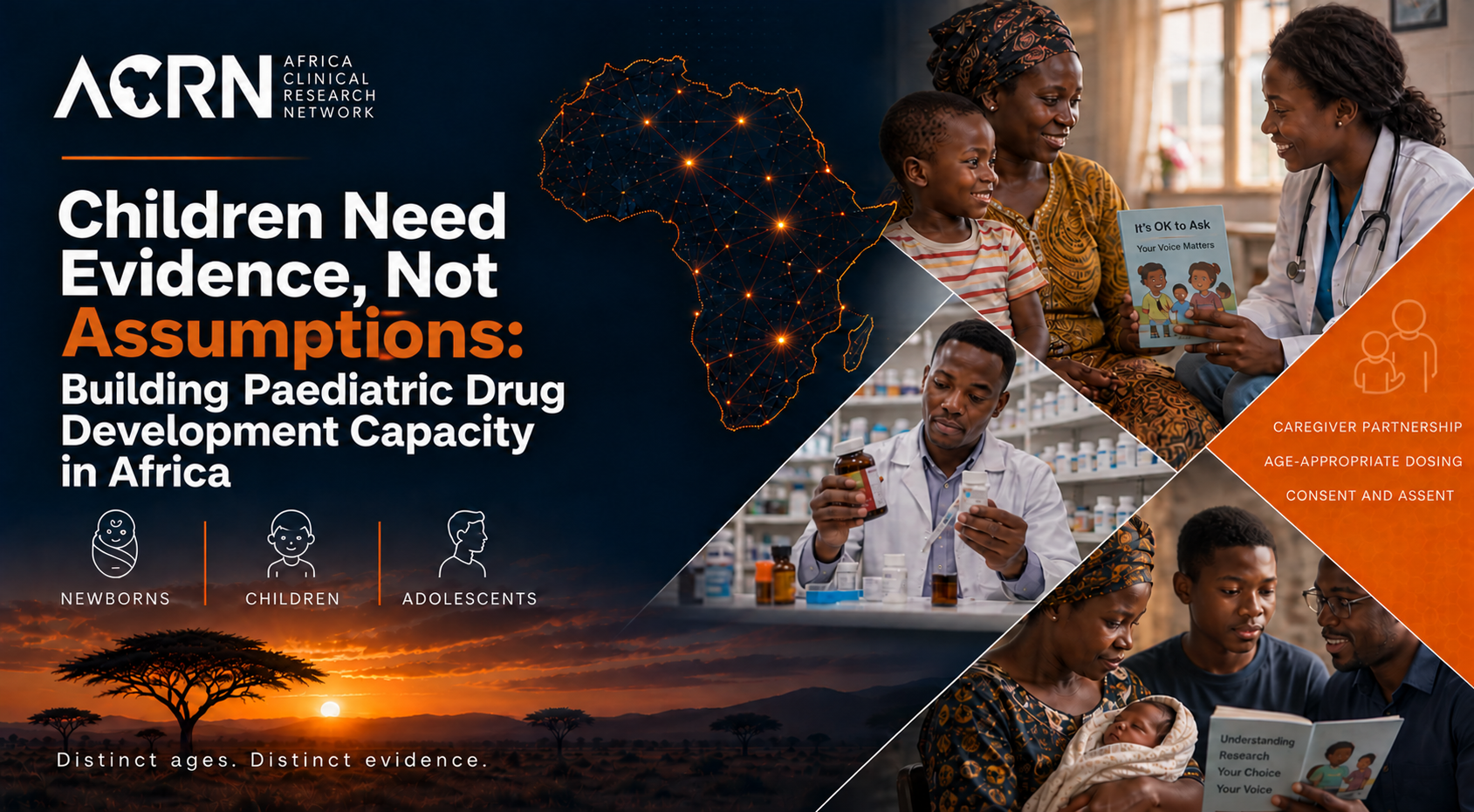
The goal is not to repeat every adult study in children. It is to know which evidence can be carried forward, which questions remain open, and who can answer them safely.
The same medicine, at the same nominal dose, can behave differently when its formulation changes.
In pharmacokinetic substudies within the ODYSSEY trial, researchers at seven centres in South Africa, Uganda and Zimbabwe examined dolutegravir dosing in children weighing less than 20 kg. Among those weighing 14 kg to less than 20 kg, a 25 mg film-coated tablet produced lower drug exposure than adult reference values. The evaluated 25 mg dispersible-tablet regimen provided appropriate pharmacokinetic profiles. The milligrams alone did not tell the whole story (1).
Answering that question required more than access to patients. It required clinical teams, careful blood sampling, reliable laboratory analysis and specialist interpretation of how the medicine behaved in children.
That is the practical meaning of paediatric drug development capability: the ability to turn an unresolved treatment question into evidence that clinicians and regulators can use.
Extrapolation is a method, not an assumption
Children are not a single biological group. Organ maturation, metabolism and development change across infancy, childhood and adolescence. Evidence relevant to an adolescent may not resolve the corresponding question in a newborn. Formulations, treatment outcomes and safety assessments must also be appropriate to the population being studied (2, 3).
But requiring every adult study to be repeated in children would create its own ethical problem: exposing participants to research that may not be necessary.
The International Council for Harmonisation’s 2024 guideline, E11A: Pediatric Extrapolation, provides a framework for navigating this distinction (2). It asks developers to assess similarities and differences in disease, drug pharmacology and treatment response between a reference population and the children for whom treatment is intended. The reference population may be adults or another paediatric age group (2).
The remaining uncertainty should determine the evidence-generation plan. Depending on the question, that may involve drug-exposure studies, modelling and simulation, controlled efficacy studies or a combination of approaches. Safety requires its own explicit assessment; it should neither be assumed from adult experience nor treated as entirely disconnected from existing evidence.
The principle is simple: use what is already known responsibly, then collect the evidence needed to address what remains uncertain.
For African institutions, the opportunity is therefore not merely to recruit into paediatric trials. It is to help shape the scientific decisions that make those trials necessary, proportionate and useful.
Readiness belongs to teams, not labels
A hospital that treats children has an important foundation for research. That does not automatically make it ready for every paediatric protocol.
Readiness should be specific to the ages, condition, medicine and procedures involved. A team experienced in adolescent outpatient studies may need different expertise and facilities before undertaking neonatal research.
Investigators and nurses need to recognise age-specific clinical risks and communicate with children at different developmental stages. Pharmacists need to prepare and administer study medicines accurately. Laboratories need methods suited to the available specimen volumes. Coordinators need workable referral, safeguarding and follow-up arrangements.
These capabilities must function together. A carefully selected sampling schedule is of little value if samples cannot be processed reliably; a suitable formulation cannot compensate for inaccurate preparation.
Ethical practice is equally dependent on people. CIOMS guidance calls for parental or legally authorised representative permission and the child’s assent according to their capacity, subject to applicable exceptions (4). Assent means meaningful engagement, not simply the absence of objection. Refusal should generally be respected, and participants who become legally capable of consenting during a study should be asked to consent to continued participation.
The relevant measure of readiness is therefore what a team can consistently demonstrate, not how many training sessions it has attended.
Design the medicine for the life in which it will be used
Paediatric formulation is not a packaging decision made after the science is complete. It is part of the science.
WHO’s 2026 formulation guidance brings together dose flexibility, acceptability, excipient safety, administration devices, packaging, stability and storage (3). It also addresses practical constraints such as access to refrigeration and suitable water for medicines requiring preparation (3).
These considerations connect clinical development with manufacturing and everyday care. A medicine may achieve the intended exposure under study conditions yet remain difficult to administer at home because of its taste, dose volume, preparation steps or storage requirements.
Children, adolescents and caregivers should help identify these problems while there is still time to change the product or protocol. Their contribution should extend beyond reviewing information sheets. Can the dose be prepared accurately? Can the schedule fit around school? Are instructions understandable when a different caregiver takes over?
The ODYSSEY findings illustrate why these questions belong together: dose, formulation and drug exposure cannot be treated as separate matters (1). Alongside IMPAACT P1093, its pharmacokinetic results informed WHO’s 2021 paediatric dolutegravir dosing guidance.
The wider lesson is not that one formulation solves every problem. It is that research should produce a usable treatment approach, not simply a successful study result.
Fund the capability between protocols
A paediatric research programme should leave an institution better able to answer the next question.
That requires an investment model that supports continuity: experienced staff, supervised specialist development, maintained laboratory and pharmacy systems, and access to expertise in modelling drug exposure and response. If these capabilities are funded only while participants are being recruited, each new protocol risks becoming another rebuilding exercise.
Regional platforms should make specialist expertise accessible without requiring every institution to reproduce every function. Shared analytical services, pharmacometric support and coordinated protocol development can be organised around clearly defined responsibilities. Common data definitions and compatible procedures should support collaboration without displacing national regulatory requirements or local ethical oversight.
Efficiency should begin at study design. Modelling and simulation can help determine what additional evidence is needed, but their assumptions and limitations must be explicit. Early engagement with regulators is important, particularly where a development plan relies heavily on existing data (2).
Funders and sponsors should also ask what remains after close-out. Can the team undertake another relevant study? Are laboratory and pharmacy capabilities maintained? Has expertise been transferred into routine institutional practice?
These questions make continuity a deliverable rather than an aspiration.
A focused agenda for ACRN
For the Africa Clinical Research Network, the useful role is to connect priority paediatric questions with the people, methods and institutions needed to answer them.
That means a disciplined sequence: identify the clinical question, assess study-specific capabilities, address the gaps and establish how specialist support will be sustained. Any claim of “paediatric readiness” should be backed by documented competencies and functioning systems, not inferred from clinical caseload.
The publication of ICH’s extrapolation framework and WHO’s updated formulation guidance provides a timely basis for this work. The scientific and product-development questions need to be considered together, with African institutions contributing from the outset rather than only when recruitment begins.
Children need protection from unnecessary research. They also need protection from treatment decisions made with avoidable uncertainty. Durable paediatric research teams make it possible to pursue both obligations: learning enough to guide care, while asking no more of children than the science requires.
References
- Waalewijn H, Chan MK, Bollen PDJ, Mujuru HA, Makumbi S, Kekitiinwa AR, et al. Dolutegravir dosing for children with HIV weighing less than 20 kg: pharmacokinetic and safety substudies nested in the open-label, multicentre, randomised, non-inferiority ODYSSEY trial. The Lancet HIV. 2022;9(5):e341–e52.
- International Council for Harmonisation of Technical Requirements for Pharmaceuticals for Human Use. Pediatric Extrapolation. International Council for Harmonisation of Technical Requirements for Pharmaceuticals for Human Use; 2024.
- World Health Organization. Development of paediatric medicines: points to consider in formulation. WHO Technical Report Series 1067, Annex 8. 2026.
- Council for International Organizations of Medical Sciences. Guideline 17: Research involving children and adolescents. In International Ethical Guidelines for Health-related Research Involving Humans. 2016.