
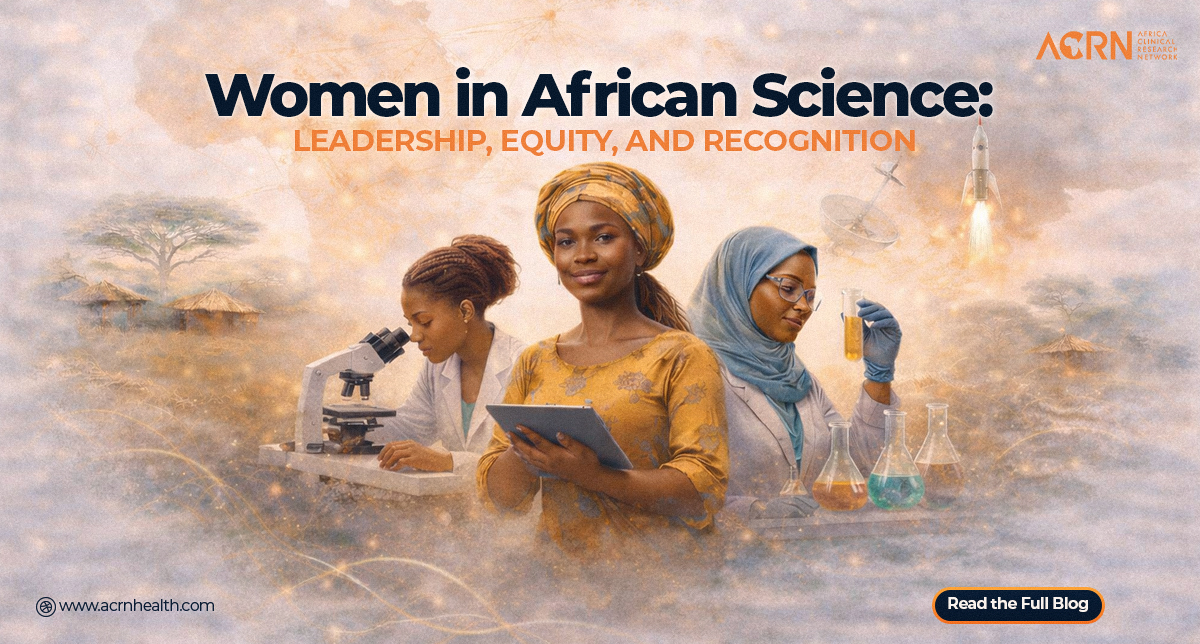
Women remain underrepresented in Africa’s research workforce overall, and they are even less visible in senior academic and scientific leadership roles. UNESCO’s latest figures show that women account for about 32% of researchers in sub-Saharan Africa, although representation varies significantly by country (1). This matters not only for individual career progression, but for the strength, diversity, and long-term resilience of African research systems. Across the continent, women are contributing to public health, biomedical science, and innovation at high levels. Yet structural barriers continue to shape who is funded, who is promoted, who is published, and whose expertise is recognized. Strengthening leadership, equity, and recognition is therefore not only a matter of fairness; it is a strategic priority for African science (2).
Leadership: Expanding the Space for Women to Lead
African women scientists are contributing across research institutions, universities, laboratories, and policy spaces, but the pathway into senior leadership remains uneven. Evidence from African research universities continues to show both horizontal segregation, where women are concentrated in some disciplines more than others, and vertical stratification, where they are more heavily represented in junior ranks than in top decision-making positions (3). That pattern has practical consequences: when fewer women progress into senior leadership, fewer are positioned to shape research agendas, mentor younger scientists, influence institutional priorities, or lead large collaborative programmes (3).
This is not a question of limited capability. Across African science, women have already demonstrated leadership in research, teaching, policy engagement, and scientific institution-building. The challenge is that strong contribution does not always translate into equal access to formal authority. In clinical research and related health fields, women contribute substantially through trial coordination, ethics oversight, regulatory work, site management, and scientific leadership, yet they remain less visible in the most senior decision-making roles. Expanding women’s leadership therefore requires more than celebrating individual success stories. It requires deliberate investment in mentorship, leadership pathways, promotion systems, and institutional cultures that do not treat women’s advancement as exceptional (3).
Equity: Addressing Structural Barriers
Achieving gender equity in science requires more than increasing the number of women entering research careers. It also requires fair access to funding, mentorship, publication opportunities, promotion pathways, and institutional support. Without those conditions, entry-level representation does not translate into equitable progression over time. Research from West Africa points to a combination of barriers that continue to shape women’s scientific careers, including gendered expectations around care responsibilities, unequal access to professional networks, institutional cultures that do not adequately support progression, and practical constraints on time, mobility, and research productivity (4).
These barriers affect more than individual careers. They also shape the kind of research system Africa is able to build. If women face unequal conditions for securing grants, publishing consistently, or progressing into senior roles, then the continent risks losing scientific leadership that it has already invested in developing. Evidence from publication data in Africa suggests that gendered patterns in research output and scientific publication remain important to understanding how recognition and advancement are distributed (5). Equity, in this sense, is not a side issue. It is part of how institutions sustain excellence, strengthen talent pipelines, and broaden the range of perspectives shaping African science (5).
Recognition: Why Visibility Still Matters
Recognition matters because it shapes who is cited, invited, funded, promoted, and remembered. Even when women are active contributors to research, they are not always equally visible in conference platforms, institutional profiles, award nominations, editorial spaces, or public scientific discourse. That affects influence as much as it affects reputation. When recognition is uneven, so too are access to collaboration, future funding, and leadership opportunity (5).
Several initiatives are working to address this gap. The Next Einstein Forum states that at least 40% of its Fellows are women, creating a platform that raises the profile of emerging African scientists in international networks (6). The Organization for Women in Science for the Developing World supports women scientists across the Global South through fellowships, awards, training, and professional networks, including early-career support designed to help women establish research groups and sustain internationally competitive work (7). These kinds of initiatives matter because visibility is not simply symbolic. Recognition can influence who gains access to networks, partnerships, speaking opportunities, and future leadership roles.
Still, visibility and recognition should not be treated as an afterthought. Where women’s contributions remain less visible in citation practices, institutional reporting, and scientific leadership narratives, disparities in influence can persist even when participation improves. A stronger research ecosystem will depend not only on bringing more women into science, but on ensuring that their work is recognized as central to the continent’s scientific future (5).
A Collective Path Forward
The barriers facing African women in science, limited leadership opportunities, inequitable access to resources, and inadequate recognition, are interconnected. Addressing them will require coordinated responses rather than isolated interventions. Mentorship matters, but so do promotion systems. Funding matters, but so do workplace culture and leadership accountability. Public recognition matters, but so do the quieter institutional decisions that shape whose work is supported, whose potential is taken seriously, and who is encouraged to step into leadership (3).
Strengthening women’s leadership and participation in science is not only an equity issue; it is also important to the quality, resilience, and relevance of African research systems. The future of African science will depend in part on whether institutions create environments in which women are able not only to enter scientific careers, but also to lead, to publish, to influence agendas, and to be recognized for the value of their work. For African research systems seeking long-term sustainability, that is not a symbolic ambition. It is part of building stronger science.
References
- UNESCO-Equatorial Guinea Fellowship Programme for Young Women [Internet]. [cited 2026 Mar 18]. Available from: https://www.unesco.org/en/prizes/equatorial-guinea/fellowships
- Gender equality in science, technology and innovation | UNESCO [Internet]. 2026 [cited 2026 Mar 18]. Available from: https://www.unesco.org/en/science-technology-and-innovation/gender-equality
- Eliminating Barriers to Women’s Participation in Science – A Study of the African Research Universities Alliance | IDRC – International Development Research Centre [Internet]. 2023 [cited 2026 Mar 18]. Available from: https://idrc-crdi.ca/en/what-we-do/projects-we-support/project/eliminating-barriers-womens-participation-science-study
- Sougou NM, Ndiaye O, Nabil F, Folayan MO, Sarr SC, Mbaye EM, et al. Barriers of West African women scientists in their research and academic careers: A qualitative research. PLOS ONE. 2022 Mar 30;17(3):e0265413. doi:10.1371/journal.pone.0265413
- Beaudry C, Prozesky H, St-Pierre C, Mirnezami SR. Factors that affect scientific publication in Africa—A gender perspective. Front Res Metr Anal. 2023 Feb 20;8:1040823. doi:10.3389/frma.2023.1040823 PubMed PMID: 36890922; PubMed Central PMCID: PMC9986590.
- NEF Fellows Programme – Next Einstein Forum [Internet]. [cited 2026 Mar 18]. Available from: https://nef.org/nef-fellows-programme/
- Capacity [Internet]. [cited 2026 Mar 18]. Available from: https://owsd.net/capacity