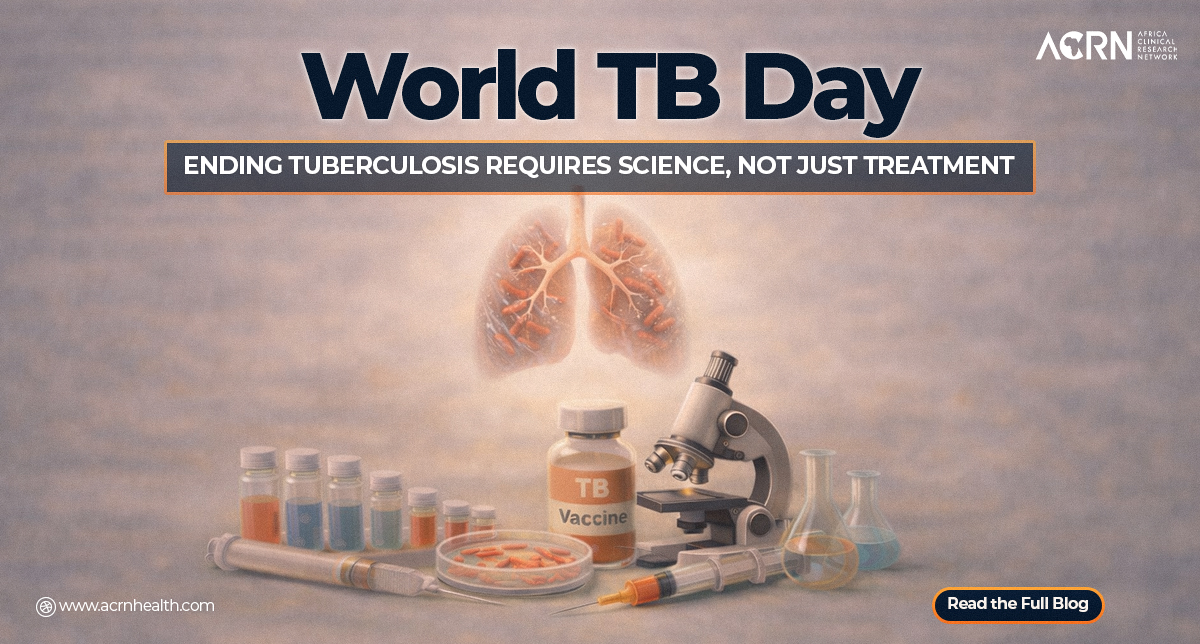
World TB Day: Ending Tuberculosis Requires Science, Not Just Treatment
Each year on 24 March, World TB Day draws attention to tuberculosis (TB), which remains one of the world’s deadliest infectious diseases. In 2024, an estimated 10.7 million people fell ill with TB and 1.23 million people died (1). The burden remains especially significant in Africa, where the WHO African Region accounted for about 25% of global TB incidence in 2024 (2).
Ending TB will require more than existing treatment programmes; it will require sustained investment in science, innovation, diagnostics, and clinical research.
TB in Africa: A Continuing Public Health Challenge
Tuberculosis, caused by Mycobacterium tuberculosis, is an airborne infectious disease that most often affects the lungs, although it can also affect other parts of the body (3).
In 2024, the WHO African Region accounted for around one quarter of global TB incidence, and the proportion of incident TB cases occurring among people living with HIV was highest in countries in this region (2).
Across many African countries, TB remains a major public health challenge, placing pressure on already constrained health systems.
The burden is shaped by a combination of delayed diagnosis, uneven access to healthcare, and social determinants such as poverty, overcrowding, and malnutrition (4). In several parts of Africa, TB/HIV co-infection continues to complicate prevention, diagnosis, and treatment efforts, increasing the need for integrated responses across programmes and services.
Although progress has been made, current rates of decline remain too slow to meet global end-TB targets. Stronger case finding, better diagnostics, improved treatment access, and more effective prevention strategies will be needed to accelerate progress.
The Urgent Threat of Drug-Resistant TB
Drug-resistant TB remains a major public health concern globally and across Africa. WHO states that multidrug-resistant TB remains a public health crisis and that only about 2 in 5 people with drug-resistant TB accessed treatment in 2024 (3).
Multidrug-resistant (MDR-TB) and extensively drug-resistant TB (XDR-TB) are significantly more difficult to treat, requiring longer and more complex treatment regimens with lower success rates.
These forms of TB are linked to delayed diagnosis, interrupted or inadequate treatment, and broader health-system weaknesses that make continuity of care harder to sustain. As resistant strains continue to spread, the need for shorter regimens, better diagnostics, and stronger treatment follow-up becomes increasingly urgent (3).
Why Clinical Research Matters
Clinical research is central to improving how TB is prevented, diagnosed, and treated. Many of the tools used today, from treatment regimens to diagnostics and vaccine candidates, have advanced through sustained scientific research and clinical trials.
Key areas of focus include:
- Developing shorter, safer, and more effective treatment regimens
- Advancing vaccine candidates and preventive strategies
- Improving rapid and accurate diagnostics, including near-point-of-care tools
- Generating implementation evidence that works in real-world settings
This matters especially in high-burden settings, where the performance of new tools depends not only on technical efficacy, but on whether they can be delivered, adopted, and sustained within routine health systems. Research is therefore not separate from implementation; it is part of how better TB care is built.
The Case for African-Led Research
Africa is not only heavily affected by TB; it is also essential to the global research response because high-burden settings are where many of the most important scientific and implementation questions need to be answered.
Conducting research in high-burden settings ensures that new interventions are evaluated in the populations most affected (5). It also strengthens local research capacity and improves the relevance of global health solutions.
When research is conducted in the settings where disease burden is highest, it becomes easier to evaluate how interventions perform under real clinical conditions, including in populations affected by co-infections, health-system constraints, and uneven access to care. That makes the resulting evidence more relevant for both local decision-making and global strategy.
Expanding clinical trial infrastructure, regulatory capacity, and scientific leadership across the continent is not only important for fairness and local ownership; it is also important for scientific validity, context-relevant evidence generation, and stronger global TB responses.
From Research to Real-World Impact
Scientific innovation alone is not enough. New tools only change outcomes when they can be delivered at scale, adopted in routine care, and linked to stronger diagnosis, treatment, and follow-up systems (6).
This requires coordinated action across stakeholders, including policymakers, funders, researchers, and healthcare systems, to ensure that scientific advances translate into meaningful health outcomes.
A Call to Action
This World TB Day, the message remains clear: ending TB will require country leadership, sustained investment, stronger uptake of new tools, and coordinated action across health systems and partners (1).
Strengthening clinical research, supporting African-led science, expanding access to better diagnostics, and improving delivery of treatment and prevention tools are all critical to accelerating progress.
TB is preventable and curable, but without sustained global action, it will remain a major public health threat.
Conclusion
Tuberculosis continues to pose a major challenge, particularly across high-burden settings in Africa. Existing tools have saved lives, but they are not sufficient on their own to end TB at the pace required.
To change this trajectory, greater investment in science, stronger research systems, and improved delivery of innovation are essential.
Ending TB is not only a public health objective; it is also a test of whether science, health systems, and political commitment can be brought together at the scale needed.
References
- World TB Day 2026 – Yes! We can End TB! Led by countries. Powered by people. [Internet]. [cited 2026 Mar 24]. Available from: https://www.who.int/campaigns/world-tb-day/2026
- 1.1 TB incidence [Internet]. [cited 2026 Mar 24]. Available from: https://www.who.int/teams/global-programme-on-tuberculosis-and-lung-health/tb-reports/global-tuberculosis-report-2025/tb-disease-burden/1-1-tb-incidence
- Tuberculosis (TB) [Internet]. [cited 2026 Mar 24]. Available from: https://www.who.int/news-room/fact-sheets/detail/tuberculosis
- 5.3 TB determinants [Internet]. [cited 2026 Mar 24]. Available from: https://www.who.int/teams/global-programme-on-tuberculosis-and-lung-health/tb-reports/global-tuberculosis-report-2025/uhc-tb-determinants/5-3-tb-determinants
- Global Strategy for TB Research and Innovation [Internet]. [cited 2026 Mar 24]. Available from: https://www.who.int/teams/global-programme-on-tuberculosis-and-lung-health/research-innovation/development-of-a-global-strategy-for-tb-research-and-innovation
- Building a tuberculosis-free world: The Lancet Commission on tuberculosis [Internet]. [cited 2026 Mar 24]. Available from: https://www.thelancet.com/commissions-do/tuberculosis-free-world