
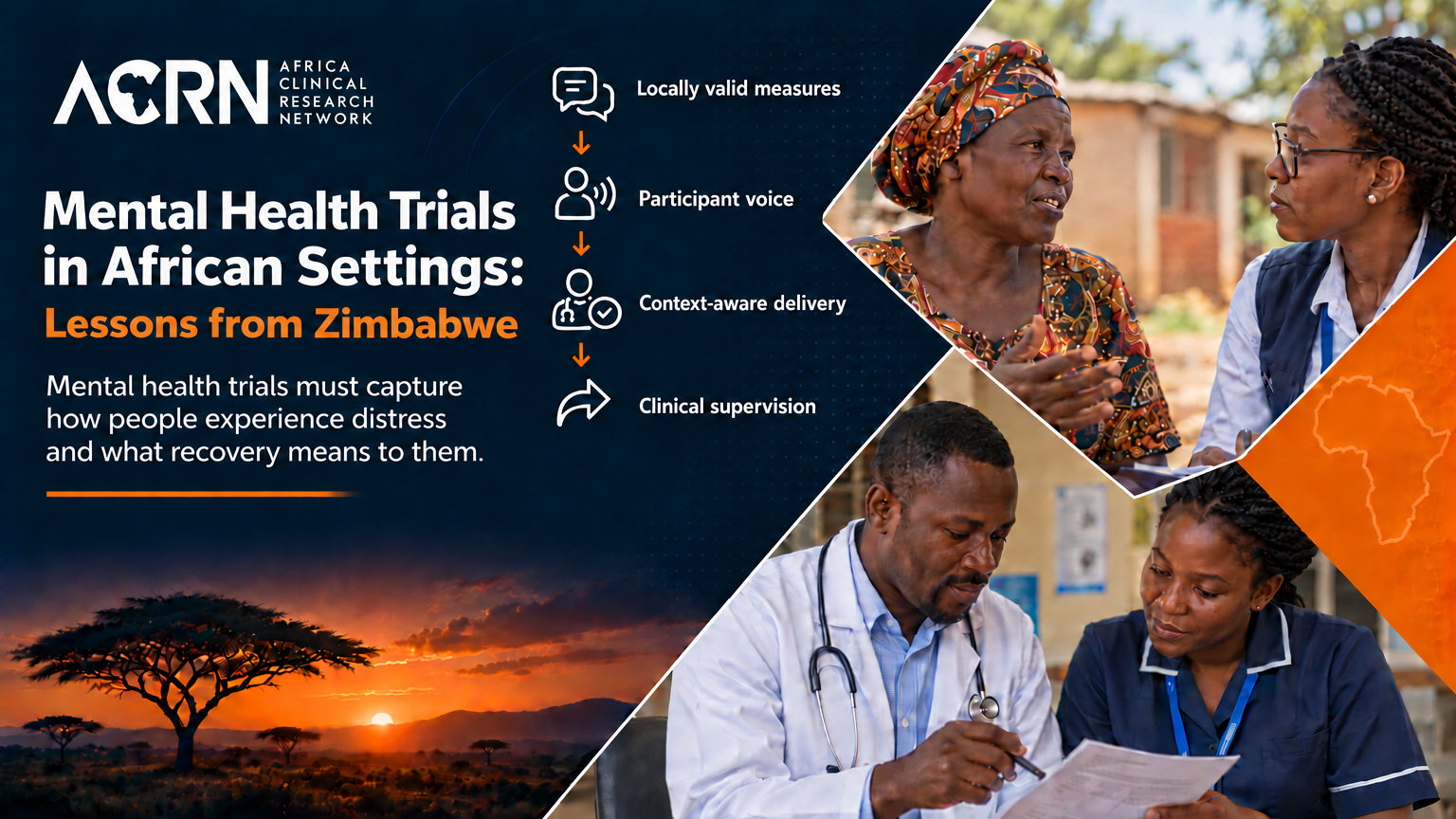
A translated questionnaire is not a validated outcome measure, and a referral list is not a care pathway. Mental health trials in African settings are strongest when both are treated as part of the science.
A mental health trial is only as good as its outcome measure. A study can have enough participants, be properly randomised and be well run, and still answer the wrong question if its central tool doesn’t capture how the people enrolled experience and describe distress. In Shona there is no direct word for “depression” or “anxiety.” Patients in Zimbabwean primary care more often describe kufungisisa, “thinking too much,” and often come in with headaches, fatigue or other physical complaints (1). A scale that misses this will undercount illness or misjudge how severe it is. It can also record improvement that participants wouldn’t call recovery.
Distress also has a context. In an early Harare study, 73% of women with depression or anxiety linked their symptoms to a specific social stressor (2), and intimate partner violence has since been associated with antenatal depression among women attending Harare clinics (3). Caregiving responsibilities, financial insecurity, gendered expectations and unequal decision-making power can shape both how distress presents and whether someone feels able to disclose it or seek help. A symptom score alone won’t explain those circumstances or the barriers to treatment. Trials need to investigate them in the population being studied, not assume them, and not generalise from one group of women, men or communities to another.
Getting measurement right matters because the need is large and services are thin. The World Health Organization (WHO) estimates that more than one billion people were living with a mental disorder in 2021 (4). Its Regional Office for Africa reports that nearly 150 million people in the region live with mental health conditions, and only nine countries have a dedicated budget line for mental health (5). Worldwide, the median is 13.5 specialised mental health workers per 100,000 people. In low- and lower-middle-income countries it falls to between 1.1 and 2.4 (6).
Where research capacity is scarce, borrowed tools fill the gap. That’s efficient. It isn’t always valid.
Translation is not validation
Translating an outcome measure word for word doesn’t show that it measures the same thing. Distress, social functioning, trauma, psychosis, substance use and recovery are all shaped by language and context. The International Test Commission (ITC) sets out 18 guidelines in six categories, from preconditions through scoring, interpretation and documentation, for showing that an adapted test measures what the original does (7). In practice that means forward and back translation, cognitive interviewing, testing reliability and validity, and checking that cut-off scores mean the same thing clinically in the new setting.
Zimbabwe offers a documented alternative to simple translation. Researchers built the Shona Symptom Questionnaire from ethnographic and qualitative work that drew out local expressions of distress, including among people seeing traditional medical practitioners.
They tested 56 draft items with 302 primary care patients and kept the 14 that best identified common mental disorders. The final list mixes locally specific and internationally recognised symptoms (8).
What a locally valid measure makes possible
That tool later anchored one of the most cited mental health trials from the continent. The Friendship Bench cluster randomised trial ran in 24 clinics in Harare and enrolled 573 participants who screened positive on the 14-item Shona Symptom Questionnaire (SSQ-14). Trained, supervised lay health workers delivered six sessions of problem-solving therapy. At six months, the intervention group had lower symptom scores than the group receiving enhanced usual care, and fewer had depressive symptoms (13.7% vs 49.9%) (9). Of the participants, 41.7% were living with human immunodeficiency virus (HIV). It’s a reminder that mental health outcomes in Africa often sit alongside infectious and chronic disease. A questionnaire alone may not distinguish whether fatigue or poor sleep reflects depression, HIV, treatment side effects or a combination of these factors, so trials need clinical assessment and analysis plans that account for coexisting illness.
The trial is also a lesson in delivery. The lay health workers, widely known as “grandmothers,” were older women already working as community health workers in Harare’s city clinics (10). They weren’t informal helpers: they were trained and supervised to deliver structured problem-solving therapy. What changed was who delivered it, how it was explained and where it was offered, on a bench in the clinic grounds. The therapeutic structure and the supervision stayed. Cultural responsiveness and evidence-based treatment weren’t competing here. The work was making a proven approach understandable, acceptable and workable without removing its core components. In qualitative work, clients and staff pointed to the workers’ standing in the community, the locally validated screen and the relevance of the therapy, and the workers still needed weekly supervision years in (10). Those are interpretations, though. The trial shows the intervention worked in the population studied. It doesn’t show which single feature, such as the providers’ age or familiarity, produced the benefit.
The questionnaire is also travelling: a Kiswahili version has now been validated (11). That doesn’t make every local instrument sound. Local measures need the same scrutiny as imported ones.
Symptom scores also aren’t the whole story. Going back to work or school, caring for children, sleeping, keeping relationships going or having fewer crisis episodes may matter more to participants than a few points on a scale. People with lived experience, caregivers, community clinicians and peer-support organisations can point to the outcomes that count, the terms that stigmatise, and risks researchers may miss.
A referral list is not a care pathway
Mental health trials will identify participants at risk of self-harm, violence, abuse or severe deterioration. A protocol can’t just record these events. It needs referral and emergency routes that actually work, trained staff, clinical supervision, and a clear statement of what care is available during the trial and after it ends.
A service can exist on paper without being within a participant’s reach. In rural Zaka district, Friendship Bench users and village health workers described long journeys on foot and borrowing money for bus fare (12). Young people in Zimbabwe have reported barriers to seeking care, including concerns about privacy, cost and service availability (13). The test of a pathway is practical: travel time and cost, whether appointments are actually available, whether privacy holds, and what happens when someone can’t attend. Those answers should shape the pathway itself.
This is hard where specialists are few. But excluding every higher-risk participant isn’t the answer, because the resulting evidence wouldn’t apply to the people who need it most. The answer is realistic planning. WHO’s Mental Health Gap Action Programme (mhGAP) Intervention Guide gives non-specialist health workers protocols for assessment and management, including for self-harm and suicide (14). It can anchor a stepped pathway that links study teams with primary care, district hospitals, community health workers and non-governmental providers. The plan must also say plainly what the trial can’t provide.
Context shapes delivery and interpretation
Stigma, cost, family beliefs, side effects or unreliable supply can all affect whether people keep taking their medication. Psychological interventions may need changes to language, format, who delivers them, session length and setting. Digital tools can reach more people, but they risk leaving out anyone without a private device or a reliable connection.
Adaptation also extends to beliefs and expectations: how people understand distress, whom they trust and what they expect from treatment. Many people in Zimbabwe seek help for mental distress from faith or traditional healers, and spiritual and clinical approaches can sit alongside each other (15, 16). Rather than treating religion as a barrier by default, researchers should explore how beliefs affect help-seeking and whether respectful referral partnerships would help. Expectations about professional authority, privacy, family involvement or receiving direct advice may also affect engagement with collaborative approaches such as problem-solving therapy or cognitive behavioural therapy (CBT). These are questions to explore with each study population, not fixed traits to attribute to Zimbabweans. Nor is adaptation evidence that externally developed approaches are inherently unsuitable. The Friendship Bench suggests the opposite.
None of this makes trials impossible. It does make mixed methods and process evaluation essential: researchers need to know whether an intervention worked, and also for whom, how, and under what delivery conditions. The Lancet Psychiatry Commission calls for building research into real-world implementation, putting equity at the centre and going beyond the traditional randomised trial. It also notes that most mental health implementation research to date has come from high-income countries (17). African teams are well placed to help close that gap.
What durable capability requires
Mental health research capability depends on people and systems working together. That means psychiatrists, psychologists, psychiatric nurses, social workers, pharmacists, primary care clinicians, qualitative researchers, statisticians, community partners and people with lived experience. It also means shared data standards, validated measures, crisis procedures and ethics guidance written for mental health research.
ACRN’s position
ACRN’s approach is to prioritise partnerships and sites that can demonstrate locally appropriate measurement, functioning referral pathways and the community relationships needed to sustain both.
The choice ahead
Africa needs more mental health evidence, but volume alone won’t close the gap. For funders, regulators and research teams, the real question is whether the next generation of trials will use measures that capture distress as participants experience it, whether the intervention’s method and delivery fit participants’ lives, and whether the support promised can actually be reached, including after the last assessment visit. That’s a matter of institutional discipline as much as resources.
References
1. Patel V, Abas M, Broadhead J, Todd C, Reeler A. Depression in developing countries: lessons from Zimbabwe. Bmj. 2001;322(7284):482–4.
2. Abas MA, Broadhead JC. Depression and anxiety among women in an urban setting in Zimbabwe. Psychol Med. 1997;27(1):59–71.
3. Kaiyo-Utete M, Dambi JM, Chingono A, Mazhandu FSM, Madziro-Ruwizhu TB, Henderson C, et al. Antenatal depression: an examination of prevalence and its associated factors among pregnant women attending Harare polyclinics. BMC Pregnancy Childbirth. 2020;20(1):197.
4. World Health Organization. World mental health: latest data. Geneva: World Health Organization; 2025. Report No.: 9789240113817.
5. World Health Organization Regional Office for Africa. Mental health conditions affect 150 million in Africa amid insufficient care services. 2025.
6. World Health Organization. Mental Health Atlas 2024. Geneva: World Health Organization; 2025 2025/09/02. Report No.: 9789240114487.
7. International Test Commission. ITC Guidelines for Translating and Adapting Tests (Second Edition). International Journal of Testing. 2018;18(2):101–34.
8. Patel V, Simunyu E, Gwanzura F, Lewis G, Mann A. The Shona Symptom Questionnaire: the development of an indigenous measure of common mental disorders in Harare. Acta Psychiatrica Scandinavica. 1997;95(6):469–75.
9. Chibanda D, Weiss HA, Verhey R, Simms V, Munjoma R, Rusakaniko S, et al. Effect of a primary care-based psychological intervention on symptoms of common mental disorders in Zimbabwe: a randomized clinical trial. JAMA. 2016;316(24):2618–26.
10. Abas M, Bowers T, Manda E, Cooper S, Machando D, Verhey R, et al. ‘Opening up the mind’: problem-solving therapy delivered by female lay health workers to improve access to evidence-based care for depression and other common mental disorders through the Friendship Bench Project in Zimbabwe. Int J Ment Health Syst. 2016;10:39.
11. Ceccolini D, Dambi J, Fatawi H, Ali S, Kühnert S. Validation of the Shona Symptom Questionnaire (SSQ-14) in Kiswahili. BMC Psychology. 2025.
12. Kidia K, Machando D, Dzoro V, Chibanda D, Abas M, Manda E, et al. Rural Friendship Bench: A qualitative study in Zaka district, Zimbabwe. Soc Sci Med. 2024;348:116791.
13. Mushonga RH, Bere TC, Jopling R, Glozah F, Anyorikeya M, Kamvura TT, et al. Barriers and enablers to help-seeking for common mental disorders among young people in low-income settings: Perspectives from Zimbabwe. PLoS One. 2025;20(11):e0335963.
14. World Health Organization. mhGAP Intervention Guide for mental, neurological and substance use disorders in non-specialized health settings: Mental Health Gap Action Programme (mhGAP), version 2.0. Geneva: World Health Organization; 2016. Report No.: 9789241549790.
15. January J, Sodi T. The Practices of Apostolic Faith Healers in Mental Health Care in Zimbabwe. Journal of Psychology in Africa. 2006;16:315–9.
16. Kajawu L, Chingarande SD, Jack H, Ward C, Taylor T. What do African traditional medical practitioners do in the treatment of mental disorders in Zimbabwe? International Journal of Culture and Mental Health. 2016;9(1):44–55.
17. McGinty EE, Alegria M, Beidas RS, Braithwaite J, Kola L, Leslie DL, et al. The Lancet Psychiatry Commission: transforming mental health implementation research. The Lancet Psychiatry. 2024.