
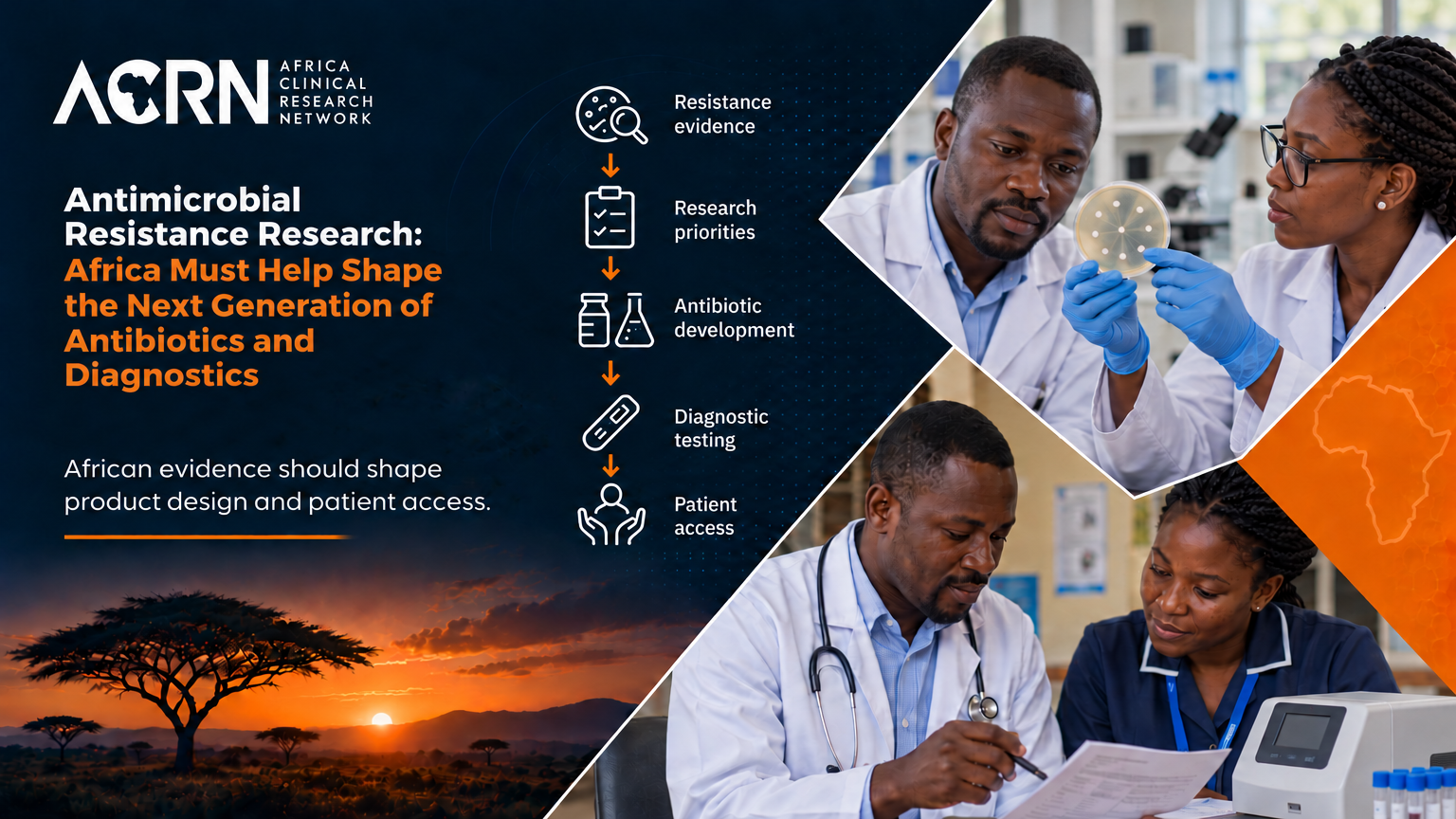
African institutions are generating evidence on resistant infections. That evidence should influence which products are developed, how they are tested, and whether patients can benefit from them.
A laboratory result can identify an antibiotic that is unlikely to work. It cannot ensure that an effective alternative reaches the patient.
Between those two events sit decisions about diagnosis, prescribing, medicine supply, affordability, and the organization of care. Connecting them should be a defining task for antimicrobial resistance research in Africa.
Surveillance is essential. But African institutions should also help determine what happens after resistance is documented: which treatments need testing, what a useful diagnostic must deliver, and how prevention and stewardship can work under everyday conditions.
World AMR Awareness Week, held from 18 to 24 November 2026, brings these questions into focus through the theme “One Health, one action: Prevent AMR now” (1). While antimicrobial resistance encompasses bacteria, viruses, fungi, and parasites, this article focuses on bacterial resistance and the research needed to preserve effective antibiotic treatment.
Let surveillance shape the research question
More detailed surveillance is creating opportunities to connect resistance findings with clinical decisions.
In June 2026, the World Health Organization reported progress in individual-level reporting through its Global Antimicrobial Resistance and Use Surveillance System, known as GLASS, in Kenya and Rwanda. Kenya’s surveillance network had expanded from two model sites in 2017 to 32 sites across 27 counties. Rwanda’s transition drew on data from four major referral hospitals (2).
These advances do not mean the evidence is complete. WHO also documented missing patient information, manual data collection, workforce constraints, and information systems that could not communicate with one another.
Linking laboratory results with clinical information makes surveillance more useful. The ACORN2 study demonstrated this approach across 19 hospitals in Africa and Asia, finding marked differences in pathogens and resistance patterns by patient age and whether infections were acquired in the community or hospital (3).
Such differences should influence development priorities. They can help researchers identify patient groups needing better treatment options, select relevant trial comparators, and define the performance required of a diagnostic.
This is where surveillance should inform target product profiles: the requirements specifying whom a product is for, what it must do, and where it must work. A test intended for a district hospital should be designed around that hospital’s treatment decisions and operating conditions, not assessed against them only after development.
Nor should findings from selected hospitals become a single specification for an entire continent. African research leadership requires enough local detail to distinguish needs across settings.
Better use of existing medicines is part of innovation
Neonatal sepsis provides a concrete example of African institutions helping generate evidence for treatment development.
The initial phase of the NeoSep1 trial, conducted in South Africa and Kenya, investigated dosing and safety of combinations involving the existing antibiotics fosfomycin, flomoxef, and amikacin. The findings supported proposed doses of fosfomycin and flomoxef for further evaluation in a larger randomized trial (4).
That distinction matters. Early dosing and safety findings do not establish that a regimen improves survival or outperforms standard treatment. In June 2026, the Global Antibiotic Research and Development Partnership reported that the larger trial had enrolled newborns in Ghana, Kenya, and South Africa and was expanding into Asia (5).
The strategic lesson is broader than neonatal care. New molecules are needed, but innovation also includes better evidence on existing medicines: which combinations to use, at what doses, for how long, and in which patients.
African institutions should help define those questions, select meaningful outcomes, and interpret differences between sites. Planning how an effective regimen could become available should begin alongside the trial, not after its results are published.
Develop diagnostics around the decisions they must change
WHO’s 2025 assessments identified continuing gaps in antibacterial innovation, pediatric formulations, and oral treatments for outpatient care. Its diagnostic assessment also highlighted limited simple tools for primary and secondary care (6).
These findings support a shared development agenda for antibiotics and diagnostics.
A diagnostic’s value cannot be judged by accuracy alone. Its specimen requirements, turnaround time, maintenance needs, and cost all matter. So does the ability of a clinician to act on the result. A rapid test offers limited benefit if the indicated medicine is unavailable or the result does not reach the prescriber.
Where appropriate antibiotic use depends on identifying a particular bacterium or resistance mechanism, the medicine and diagnostic should have coordinated evidence plans. Studies should examine time to appropriate treatment, prescribing changes, patient outcomes, and costs, alongside laboratory performance.
Patients and caregivers should help shape these plans. They can identify barriers such as repeat visits, transport expenses, and difficulty obtaining prescribed treatment. Their involvement should influence the study and proposed service, with feedback explaining what changed.
The question is not simply whether a test works. It is whether the test helps care work better.
Make access and stewardship a joint design problem
Stewardship means using antibiotics appropriately to improve care and preserve their effectiveness. It should not be reduced to prescribing less.
A reduction in use is not a success if patients who need treatment cannot obtain it. Equally, wider availability without appropriate prescribing can undermine a medicine’s usefulness. Research should measure unnecessary use and unmet treatment needs together.
Practical studies could evaluate diagnostic-guided prescribing, timely treatment review, and shorter or more targeted regimens where clinically appropriate. Patient outcomes and safety must remain central. Staffing, laboratory turnaround times, medicine shortages, and follow-up arrangements should be measured rather than treated as background conditions.
Access planning also needs to connect clinical development with regulation, procurement, and manufacturing. Sponsors, regulators, manufacturers, and health services should discuss evidence requirements, suitable formulations, affordability, and reliable supply before introduction.
The financing question deserves particular attention: how can purchasers support dependable antibiotic supply without making increasing sales volumes the objective? Proposed models should be assessed for both availability and appropriate use.
After introduction, linked surveillance and clinical data should help monitor resistance, safety, prescribing, and outcomes. The evidence system should continue learning once a product enters routine care.
Give prevention an equally practical research agenda
The updated Global Action Plan on Antimicrobial Resistance for 2026 to 2036, adopted by the World Health Assembly in May 2026, emphasizes a coordinated One Health response. Its prevention priorities include vaccination, infection prevention and control, water and sanitation, biosecurity, and environmental measures (7).
For research, this means asking which interventions prevent infections, reduce antibiotic need, and can be sustained.
Vaccine development and implementation studies should examine relevant effects on infection, antibiotic use, and resistant disease. Hospital infection-prevention studies should assess effectiveness alongside the staffing, supplies, and costs required to maintain it. Environmental and animal-health research should identify actionable opportunities to reduce exposure and spread.
One Health studies need more than samples collected across sectors. They require compatible methods, agreed data governance, and a clear decision the findings will inform. Similar resistance patterns in people, animals, or wastewater warrant investigation; they do not, by themselves, establish transmission or its direction.
Prevention belongs alongside treatment development because a useful AMR research agenda must address both how infections are treated and how they can be avoided.
Put African evidence where product decisions are made
The immediate priority is to connect evidence generation with authority over research and investment decisions.
Governments and funders should support clinical and laboratory systems that identify unanswered treatment and prevention questions. Developers should involve African institutions before product specifications and trial designs are fixed. Research agreements should establish meaningful responsibilities in design, analysis, interpretation, and access planning.
For the Africa Clinical Research Network (ACRN), a credible contribution would be to connect institutions around defined questions, verified clinical and laboratory capabilities, and shared quality standards. That work should build on national priorities and agreed partnerships, with a clear purpose for each participating site.
Progress should be judged by whether evidence changes development priorities and improves care, not simply by the number of reports published or trials hosted.
Africa should help shape the next generation of antibiotics and diagnostics because the conditions in which those tools must work belong in their design. A resistance result should lead to a better treatment decision, and that decision should lead to care the patient can actually receive.
References
- World Health Organization. World AMR Awareness Week 2026: One Health, one action: Prevent AMR now: World Health Organization; 2026 Available from: https://www.who.int/campaigns/world-amr-awareness-week/world-amr-awareness-week-2026
- World Health Organization Regional Office for Africa. Kenya, Rwanda strengthen their defences against antimicrobial resistance 2026 Available from: https://www.afro.who.int/news/kenya-rwanda-strengthen-their-defences-against-antimicrobial-resistance
- Hopkins J, Lee SJ, Waithira N, Painter C, Ling CL, Roberts T, et al. Prospective characterisation of drug-resistant bloodstream infections in Africa and Asia (ACORN2): a surveillance network assessment. The Lancet Microbe. 2025.
- Bekker A, Panjasawatwong N, Hill LF, Stohr W, Walker AS, Ellis S, et al. Pharmacokinetics and safety of fosfomycin and flomoxef administered as part of neonatal sepsis treatment (NeoSep1 Part 1). Antimicrobial Agents and Chemotherapy. 2026;70(2):e0112625.
- Global Antibiotic Research and Development Partnership. Landmark clinical trial to transform treatment options for newborns with sepsis expands to Asia 2026 Available from: https://gardp.org/landmark-clinical-trial-to-transform-treatment-options-for-newborns-with-sepsis-expands-to-asia/
- World Health Organization. WHO releases new reports on new tests and treatments in development for bacterial infections Geneva: World Health Organization; 2025 Available from: https://www.who.int/news/item/02-10-2025-who-releases-new-reports-on-new-tests-and-treatments-in-development-for-bacterial-infections
- World Health Organization. The World Health Assembly adopts updated Global Action Plan on Antimicrobial Resistance (2026–2036) 2026 Available from: https://www.who.int/news/item/25-05-2026-the-world-health-assembly-adopts-updated-global-action-plan-on-antimicrobial-resistance-(2026-2036)